


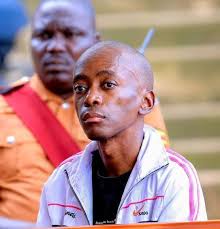
Christopher Okello Onyum
The High Court has sentenced Christopher Okello Onyum to death for the murder of four toddlers at Ggaba Early Childhood Development Centre, describing the crime as “barbaric” and among the “rarest of the rare.”
Delivering judgment, Justice Alice Komuhangi Khaukha said the gravity, planning, and cruelty of the April 2, 2026 killings warranted the ultimate penalty under Ugandan law.
The judge ruled that the victims—children all under the age of three—were particularly vulnerable and defenseless, and that the attack, carried out in a daycare setting, shattered what should have been a place of safety.
“The court finds no justification for a person to deliberately target innocent children and slaughter them in their place of safety,” she said.
Mitigation Rejected
Defense lawyer Sarah Awelo had urged the court to consider a lesser sentence, citing the convict’s background, including a difficult upbringing and his condition of sickle cell anemia. She argued that Okello was a first-time offender who could still be rehabilitated.
However, the court dismissed these arguments, stating that personal circumstances could not excuse such extreme brutality.
Justice Komuhangi Khaukha also noted the convict’s lack of remorse. Despite being given multiple opportunities to speak before sentencing, Okello remained silent and did not apologise to the victims’ families.
“Calculated and Ritualistic”
Prosecutors, led by Jonathan Muwaganya, described the killings as a premeditated act rather than a spontaneous incident. The court agreed, citing evidence of planning and the use of what was described as “sophisticated methods.”
The judge further observed that the murders bore hallmarks of ritual sacrifice, a factor that significantly aggravated the case.
“The sentence must serve not only as punishment to the convict but also as a warning to others who may engage in similar acts,” she said.
Trauma and National Concern
Court heard that the attack left deep psychological scars on survivors and families, some of whom were unable to sit through proceedings due to grief.
A probation report presented by KCCA detailed the devastating impact on the victims’ families, describing lives “irreversibly broken.”
The prosecution also linked the case to broader concerns about violent crime in Uganda, citing police data showing thousands of homicide cases recorded annually in recent years.
Death Penalty Context
While the death sentence remains legal in Uganda, it is no longer mandatory following the landmark Susan Kigula Supreme Court ruling in 2009, which gave judges discretion to apply it only in exceptional cases.
Although courts continue to hand down death sentences, Uganda has not carried out a civilian execution since 1999, when several inmates were executed at Luzira Prison.
The victims of the attack were identified as Ryan Odeke, Keisha Agenorwoth Otim, Gideon Eteku, and Ignatius Sseruyange.
The killings occurred in broad daylight at the daycare centre, turning what prosecutors described as a “sanctuary” into a scene of terror.














Leave a Reply