


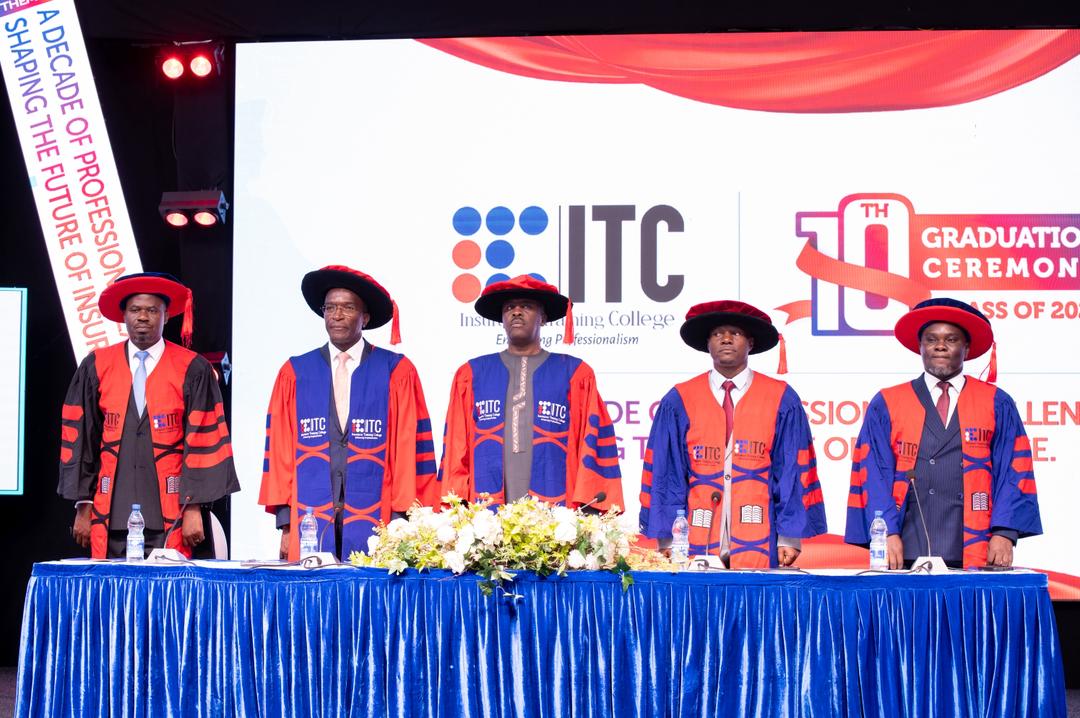
L-R Mr. Protazio Sande, Member, Alhaj Dr.Kaddunabbi ibrahim Lubega, CEO, Gen. David Muhoozi, State Minister for internal Affairs, Dr. Abdul Hafiz Walusimbi, Chairman Board and Mr. Saul SSeremba CEO/Principal ICT during the 10th graduation ceremony at Hotel African.
Uganda’s insurance sector has quietly grown into one of the country’s largest professional employers, now engaging over 6,000 specialists across key areas, including underwriting, claims management, risk assessment, actuarial science, compliance, and customer service.
In addition, 3,600 certified insurance agents serve as frontline distributors of insurance products, bringing the total number of insurance professionals in the country to nearly 10,000, stressing the sector’s increasing relevance to Uganda’s economic ecosystem.
According to Ibrahim Kaddunabbi Lubega, Chief Executive Officer of the Insurance Regulatory Authority (IRA), the sector’s rapid expansion is driven by rising demand for insurance services.
“As businesses, households, and institutions navigate financial uncertainties, from climate-related losses to health risks and property vulnerabilities, the need for professionally trained insurance personnel has surged,” he said.
Kaddunabbi emphasized that this growth not only supports employment but also strengthens national resilience by ensuring that financial shocks are absorbed more effectively.
He acknowledged the Insurance Training College (ITC) for playing a pivotal role in developing the skilled workforce powering the sector. Through structured programs in underwriting, claims handling, risk management, and specialized courses such as actuarial studies and insurance law, ITC has created a pipeline of professionals equipped to meet the evolving demands of the market.
“Insurers report that this expanded talent base has improved service delivery, enhanced claims processing standards, and raised overall professionalism within the industry,” Kaddunabbi said during ITC’s 10th graduation ceremony.
He said certified insurance agents, who now number 3,600, also play a critical role, because they interpret complex insurance products, advise clients, and link consumers to appropriate coverage.
He said their contribution is especially vital as government policies, including consumer awareness campaigns and microinsurance regulations, aim to extend insurance services to rural and underserved communities.
“Insurance is no longer a niche service, but a major pillar of Uganda’s economic stability,” Kaddunabbi said, noting that in addition to direct employment, the sector supports thousands more indirectly through distribution networks, technology firms, training institutions, and ancillary services such as medical assessors and surveyors.

A Sector Poised for Growth
Analysts predict that Uganda’s insurance workforce will continue to expand as digital transformation accelerates and the demand for climate, health, agricultural, and cyber-risk solutions grows. With regulatory reforms, investments in professional training, and an increasing awareness of risk management among Ugandans, the industry is well-positioned to shape the future of work and financial security in the country.
Saul Sseremba, Principal of ITC, highlighted the sector’s growing influence during the graduation ceremony. “As Uganda’s economy evolves, this expanding workforce will play a decisive role in driving national development, enhancing resilience, and supporting millions of Ugandans through life’s uncertainties—one claim, one policy, and one professional at a time,” he said.
This year marked a historic moment for ITC, with the graduation of its first cohort from the Advanced Diploma in Insurance—the highest professional qualification offered by the institution. With this milestone, ITC became the first college in East and Central Africa to award advanced-level insurance diplomas, reinforcing its position as a regional leader in insurance training and capacity building.
The graduation also celebrated ITC’s first cohort of Rwandan students, showcasing the institution’s growing regional footprint. With more than 8,000 graduates trained through homegrown programs, ITC continues to be a reliable pipeline of skilled professionals for Uganda’s insurance sector.
Insurance, Security, and National Stability
Keynote speaker Gen. David Muhoozi, who is also the State Minister for Internal Affairs, stressed the critical link between insurance, economic stability, and national security.
“People’s protection goes beyond the physical realm. Insurance is at the core of human security, ensuring shelter, food, health, and social security. By studying insurance, graduates are contributing directly to the law, order, and peace of mind that the government is sworn to uphold,” he said.
Citing the IRA’s 2024 report, Gen. Muhoozi commended the sector for paying Shs887.4 billion in claims last year, arguing that this was: “businesses saved, homes rebuilt, and livelihoods restored—a direct injection of stability into our economy.”
The minister further stressed the urgent need to expand agricultural insurance. With 70% of Ugandans dependent on farming but less than one percent of farmers insured, he called the protection gap “a national vulnerability.”
He emphasized that closing this gap would not only safeguard livelihoods but also reduce socioeconomic shocks that could lead to crime, reinforcing the trinity of security, stability, and prosperity.
Muhoozi said with nearly 10,000 professionals already active and a robust training system in place, Uganda is poised to see further expansion in both coverage and employment.
He said graduates of ITC, along with the sector’s certified agents and professionals, are not just entering jobs, but becoming architects of Uganda’s financial resilience and contributors to national development.













Leave a Reply