


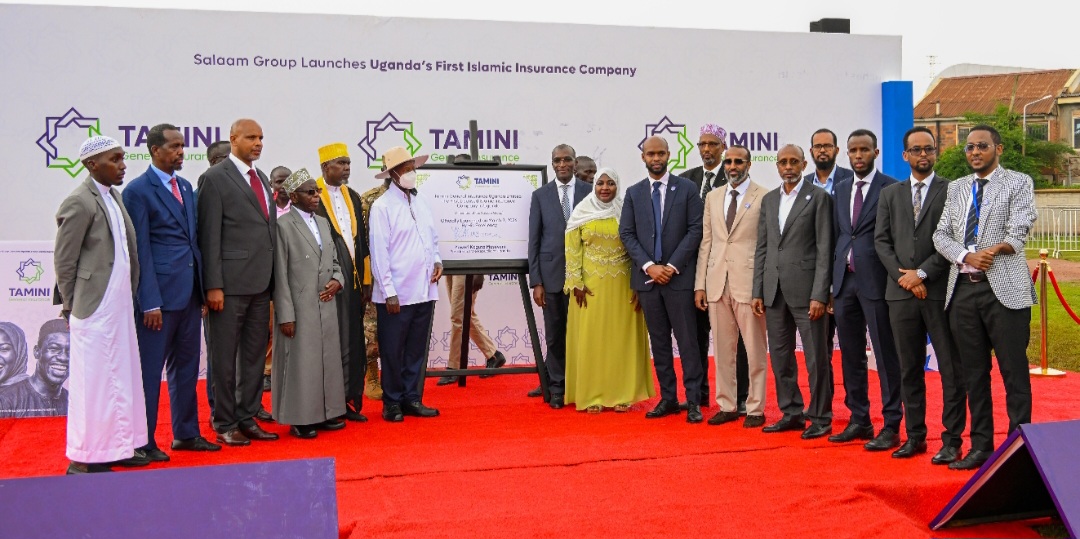
President Yoweri Kaguta Museveni has officially launched Tamini General Insurance, Uganda’s first Sharia-compliant insurance company, marking a significant milestone in the country’s financial sector.
The launch took place at Millennium Park in Lugogo, Kampala, during an Iftar dinner organised by the Senior Presidential Advisor on Political Affairs and Head of the NRM National Chairman’s Office, Hajjat Hadijah Namyalo.
Tamini General Insurance, a member of the Salaam Group conglomerate, has been established to provide Sharia-based insurance services founded on principles of mutual benefit, joint guarantee and ethical investment. The company aims to offer alternative insurance solutions that comply with Islamic financial principles while remaining inclusive to a broad segment of Ugandans.
Welcoming Salaam Group to Uganda, President Museveni described the country as a rapidly expanding market of over 45 million people, with projections expected to reach 100 million by 2050.
“Uganda is a growing market. You are coming at the right time,” the President said, encouraging investors to take advantage of the country’s demographic and economic potential.
He urged the Muslim community to prioritise investment in commercially viable ventures rather than consumptive spending, noting that sustainable wealth creation remains key to poverty eradication.
The President commended Salaam Group for offering integrated financial services that combine financing and insurance, describing the model as a complete financial cycle.

“When you borrow to invest, you must also prepare for risks. Insurance provides that backup. I thank Tamini for completing the cycle,” he said.
President Museveni further reiterated government commitment to interest-free wealth creation initiatives such as the Parish Development Model (PDM). He clarified that the six per cent annual charge attached to PDM funds is intended to control inflation and maintain the stability of the revolving fund.
He called upon the Muslim community to embrace such government programmes to uplift households still trapped in subsistence living, noting that about 30 per cent of Ugandans remain outside the money economy.
The President also directed PDM management committees to adopt a matrilineal approach when selecting beneficiaries, arguing that tracing eligibility through the female line would promote inclusion, particularly in polygamous and women-led households.
In addition, he praised women for their active role in economic development and pledged to increase government financial support to Muslim women’s groups from Shs2 billion to Shs20 billion.
Tamini Insurance Group CEO, Mr Mohamed Bahdon, outlined three operational pillars for the company: ethical investment, transparent oversight and collective participation. He said the firm’s entry into Uganda would enhance financial inclusion and support the country’s Vision 2040 agenda.
“A farmer who accesses halal financing from Salaam Bank can now insure that crop through Tamini. This strengthens productivity and moves Uganda from consumption to production,” Bahdon noted.
The Chief Executive Officer of the Insurance Regulatory Authority of Uganda, Alhaji Ibrahim Kaddunabbi Lubega, reported that Uganda’s insurance sector has grown to over Shs2 trillion. He expressed optimism that the introduction of Sharia-compliant insurance would further expand the industry.
Globally, Islamic insurance is currently valued at approximately USD 36.6 billion and is projected to exceed USD 75 billion by 2033, signalling significant growth opportunities for Uganda’s market.
Hajjat Namyalo said Tamini General Insurance will pay particular attention to the informal sector, including market vendors and communities prone to disasters, to ensure broader coverage.
Sheikh Muhammad Yunus Kamoga, a leader within the Tabliq Muslim sect, thanked the President for his continued engagement with the Muslim community and for supporting the growth of Muslim education and financial institutions in Uganda.
The launch of Tamini General Insurance adds a new dimension to Uganda’s financial services landscape, positioning the country to tap into the expanding global Islamic finance market while promoting inclusive economic growth.








Leave a Reply