


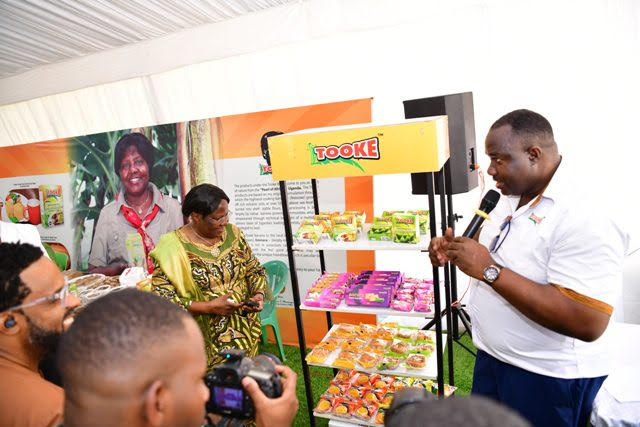
Uganda’s flagship banana innovation, Tooke, has officially moved from years of scientific research into full-scale Commercialisation, marking a major milestone for the Presidential Initiative on Banana Industrial Development (PIBID) and its commercial arm, the Banana Industrial Research and Development Centre (BIRDC).
After extensive testing in both local and export markets, demand, particularly in Europe, is rising steadily. Lead scientist and Tooke inventor, Prof. Florence Muranga, says the brand is now ready for global scaling as consumption spreads among health-conscious consumers.
Speaking on the sidelines of the launch of the Create and Cook with Tooke culinary competition, Prof. Muranga, noted that with expanded production, Tooke flour has the potential to dominate the domestic market and drastically reduce the USD 500 million Uganda spends annually on wheat imports.
“A single bunch of matooke sold locally at around Shs 30,000 produces about four kilograms of Tooke flour, each valued at USD 13 (Shs 47,000) on international markets. The value farmers can earn through processing is far higher than what they get from selling raw bananas,” she said.
According to Prof. Muranga, Tooke flour is gaining faster acceptance abroad than at home. The flour, which is gluten-free, rich in fibre and resistant starch, and low in calories, appeals to markets struggling with lifestyle diseases linked to wheat consumption.
“Science shows that Tooke flour supports better digestion, lowers the risk of hypertension, and reduces exposure to cancers associated with refined wheat,” she said.
Launched in 2005 after President Museveni endorsed Prof. Muranga’6 research, the product has since attained both local and international quality certifications. Tooke flour is now used in bread, cakes, biscuits, baby foods, and a growing array of value-added products.
The competition
The challenge was designed to showcase the versatility of banana-based products. Running from January to March 2026, it will bring together chefs, bakers, and culinary creatives from across the country.
“Entries are now open to the public, and the Grand Finale in April 2026 will coincide with the 21st Anniversary of PIBID,” Prof. Muranga said.
Participants must be professional chefs with at least three years of experience, or pastry chefs with five. They will undergo training and compete in qualifiers, semifinals and finals, judged on creativity, taste, presentation, and innovation in using Tooke flour. The top winners will receive professional promotion and online marketing support.
Prof. Muranga said that despite a slow journey, Tooke’s transition from research to Commercialisation has already created new income streams, jobs, food security options, and export opportunities.
“This move has boosted household incomes, created employment, and opened a path for Ugandan products to penetrate markets that value healthy, gluten-free foods,” she said.
Expanding Production and Strengthening the Value Chain
According to Mathew Bagonza, a member of the Presidential Advisory Committee on Exports and Industrial Development (PACEID), PIBID has developed a 24-acre banana mother garden with 52 varieties, transformed the once-dilapidated Nyaruzinga District Farm Institute into a Technology Business Incubator, and established a research and processing facility.
Under expansion plans, he said, a large-scale processing facility will be set up at the Ishara Industrial Technology Park, covering 640 acres. Production of dried banana flour is expected to increase from 1.4 tonnes per day to 10–14 tonnes, with diversification into fish and livestock feeds.
According to Bagonza, Tooke is among the value-addition projects with the greatest potential to boost Uganda’s foreign exchange. “The global trend is shifting towards healthier flours, and banana flour is gaining ground, especially in the UK,” he said.
A Crop with Cultural and Economic Power
Bananas are grown by more than 75% of Ugandan farmers, with annual production exceeding six million tonnes. Uganda also has the world’s highest per capita banana consumption, of between 220 and 400 kilograms per person per year, according to UNDP.
Entrepreneurs are now venturing into new banana-based products ranging from snacks and beverages to fibres used in industrial threads.
Globally, the banana export market is dominated by Ecuador, the Philippines, and Costa Rica. Uganda, exporting only USD 6,355 worth of bananas in 2023, has vast untapped potential in value-added products like dry banana flour, used in ice creams, puddings, cakes, biscuits, cereals, and flavouring agents.












Leave a Reply