



Businesses trading with the Middle East and Europe are facing increasing pressure from global supply chain disruptions, rising transportation costs and currency volatility driven by ongoing geopolitical tensions.
In response, dfcu Bank says it is stepping in with financial and risk management solutions aimed at helping clients navigate the uncertainty and sustain their operations.
Speaking during the dfcu Bank– Netherlands Platform for Investment in Uganda (NUTIP) Partnership Event held at the bank’s headquarters in Nakasero, Philip Nuwamanya, Head of Coverage for Corporate and Investment Banking at dfcu Bank, said the lender is already seeing the effects of instability in global markets on several Ugandan businesses.
“We do understand that the situation in the Middle East has caused supply chain disruptions for our clients,” Nuwamanya said.
He explained that companies that rely on imported raw materials and international shipping routes are increasingly facing operational challenges as geopolitical tensions disrupt global logistics networks.
“Some of our clients are seeing longer lead times in terms of delivering raw materials, while others are experiencing higher transportation costs because of the rising cost of fuel,” he noted.
Global trade routes have in recent months been affected by conflicts and security concerns in key maritime corridors linking Europe, the Middle East and Asia. These disruptions have slowed cargo movement, increased insurance costs for shipments and forced many shipping companies to alter traditional routes, leading to delays and higher freight charges.
For Ugandan businesses that depend on imported inputs such as machinery, industrial materials and finished goods, such disruptions can significantly affect production schedules and inventory planning. Importers often operate on tight timelines to meet market demand, and delays in shipments can quickly translate into lost revenue or operational bottlenecks.
According to Nuwamanya, such disruptions can create serious financial pressure for businesses that depend on predictable supply chains to maintain production schedules and meet market demand.
To help address these challenges, the bank is offering working capital solutions aimed at helping companies bridge financing gaps caused by delays in shipments or unexpected increases in operational costs.
“We are ready to come in as their partner to support them with working capital solutions to bridge these financing gaps as we wait for the situation to normalize,” Nuwamanya said.
Working capital financing enables businesses to access short-term liquidity to cover operational expenses, pay suppliers and maintain production even when supply chains are disrupted. This support is particularly critical for manufacturers and traders that depend on steady imports of raw materials.
Industry analysts note that during periods of global uncertainty, businesses often experience cash flow constraints as operational costs increase while revenue inflows remain uncertain. Access to flexible financing can therefore help companies continue operations and maintain employment levels even when external conditions are unstable.
Beyond supply chain disruptions, businesses involved in international trade are also facing growing risks related to currency volatility.
Nuwamanya noted that fluctuations in the exchange rate have become a major concern for both importers and exporters as global economic uncertainty continues to influence foreign exchange markets.
“The exchange rate has depreciated and this has created currency fluctuations that businesses must manage,” he explained.
Currency movements can significantly affect the cost of imports and the value of export earnings, particularly for companies that conduct transactions in major international currencies such as the US dollar or the euro. When exchange rates shift suddenly, businesses can face unexpected losses or cost increases.
To help mitigate these risks, dfcu Bank is offering foreign exchange hedging solutions that allow companies to protect themselves against sudden movements in currency markets.
“We are offering hedging solutions to our clients to help them manage the fluctuations in the exchange rate,” he said.
Hedging instruments enable businesses to lock in exchange rates for future transactions, reducing uncertainty and allowing companies to plan their finances more effectively when engaging in cross-border trade.
Such financial tools are increasingly becoming important for companies that operate in international markets where exchange rate movements can significantly influence profitability.
Meanwhile, dfcu Bank is also strengthening international partnerships aimed at supporting trade and investment between Uganda and Europe.
Nuwamanya highlighted a collaboration involving dfcu Bank, Rabobank from the Netherlands, the NUTIP and the Embassy of the Kingdom of the Netherlands.
“This partnership has four key players. We have dfcu Bank, Rabobank from the Netherlands, NUTIP, which is the Netherlands platform for investment in Uganda, and the Embassy of the Kingdom of the Netherlands,” he said.
The partnership is designed to provide financing, advisory services and market linkages for businesses exporting to the Netherlands as well as Dutch companies investing in Uganda.
Trade between Uganda and the Netherlands has grown steadily over the years, particularly in sectors such as agriculture, horticulture, logistics and manufacturing. The Netherlands is among the largest European importers of Ugandan agricultural products, including coffee, flowers and fresh produce.
By strengthening financial collaboration between institutions in both countries, the initiative aims to make it easier for businesses to access capital, technical support and international market opportunities.
“If you are a Ugandan entity that sells into the Netherlands as your end market, or you are a Netherlands business operating in Uganda, this is the right platform and the right channel for you to get the support that you need,” Nuwamanya said.
The partnership also seeks to deepen economic ties between Uganda and the Netherlands by creating a structured platform through which businesses can engage financial institutions and development partners more effectively.
As global economic conditions continue to shift, he emphasized that financial institutions must play a proactive role in helping businesses remain resilient during periods of uncertainty.
Banks, he said, must go beyond traditional lending by providing strategic financial solutions that enable companies to manage risk, maintain liquidity and continue expanding their operations even when global markets become volatile.
“Our role as a bank is to partner with our clients during difficult periods and ensure they have the financial support they need to keep their businesses running,” he said.
With global supply chains still adjusting to geopolitical tensions, energy price fluctuations and shifting trade patterns, many businesses are expected to continue facing operational challenges in the near term.
BOU Remains Optimistic
Dr. Adam Mugume, Director of Research and Policy at the Bank of Uganda, said the economy expanded by an average of about 6.3%t during the first three quarters of the year.
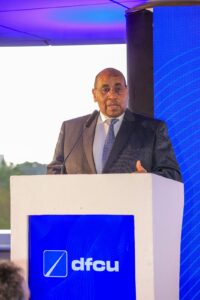 Dr. Adam Mugume, Director of Research and Policy at the Bank of Uganda
“We saw growth coming in, averaging around 6.3 percent in the three quarters of 2025, and we are now waiting for the data for the last quarter,” Mugume said.
He noted that economic growth has largely been driven by strong domestic demand supported by both household consumption and government spending.
“On the expenditure side, growth has been driven by both households and also government expenditure,” Mugume explained.
The central bank expects Uganda’s economy to maintain a strong growth trajectory in the coming financial year.
“The outlook for 2025–2026 is robust. We estimate growth in the range of 6.5% to 7%,” Mugume said.
Over the medium term, economic growth could rise even further as the country prepares for the anticipated start of oil exports. “In the next four years, we see growth coming in the range of around eight percent, which is quite impressive compared to the average growth in Sub-Saharan Africa,” he added.
Despite this optimism, Mugume emphasized that agriculture will remain a critical pillar of Uganda’s economy even as the oil sector expands.
“There is no way you can have growth from oil without agriculture,” he said. He noted that agriculture contributes about 24 to 25% of Uganda’s Gross Domestic Product but remains highly vulnerable to weather conditions because most farming activities depend on rainfall.
“One of the biggest risks is the weather. Agriculture contributes around 24 to 25% of GDP and most of it depends on rainfall,” Mugume explained.
Inflation, however, remains relatively stable. Mugume said the central bank’s primary responsibility is to maintain price stability, which forms the foundation for sustainable economic growth.
However, financial sector players such as dfcu Bank say targeted financial support, risk management solutions and international partnerships will play a critical role in helping companies remain resilient and competitive in an increasingly unpredictable global trading environment.












Leave a Reply