


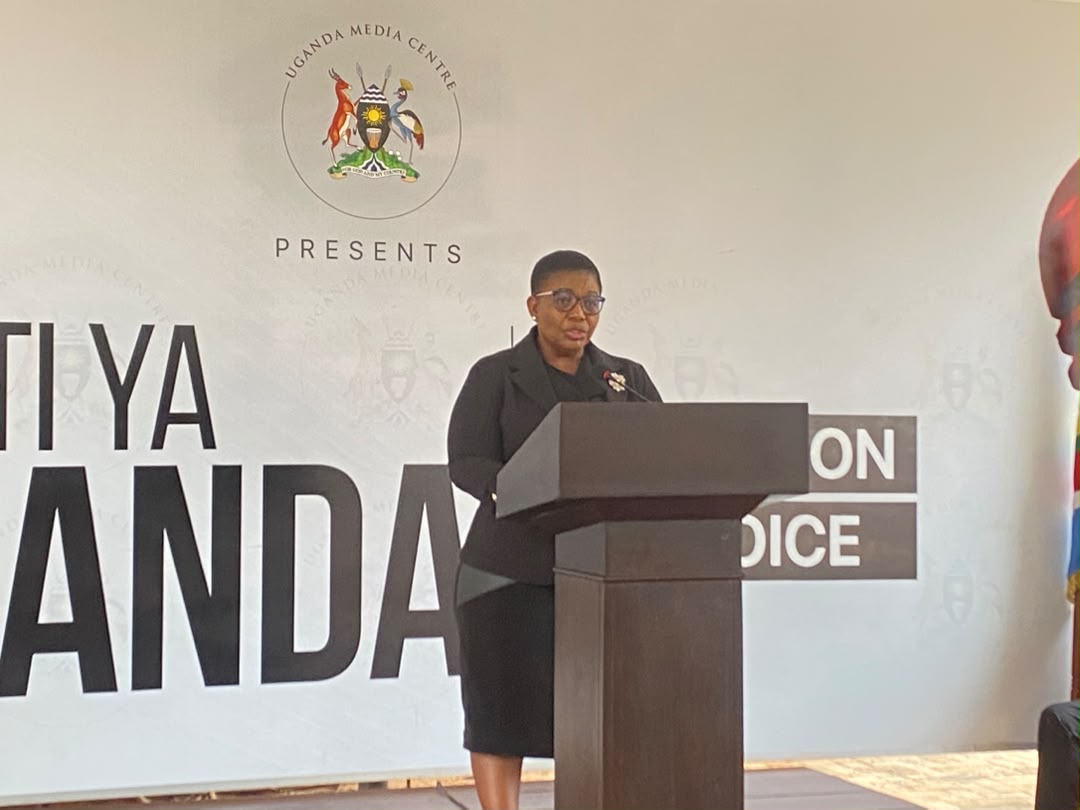
Minister of ICT and National Guidance Justine Kasule Lumumba
The government has ordered traders operating in basement spaces originally designated for parking in Kampala buildings to vacate immediately, in a move aimed at reducing flood risks following last year’s destruction of businesses in the city centre.
The directive, announced by Minister of ICT and National Guidance Justine Kasule Lumumba on November 10, follows a Cabinet meeting held on November 9, which also approved a Shs20 billion support package for traders affected by the October 2025 floods.
The decision could affect businesses operating in several commercial buildings across Kampala, particularly those that converted underground parking areas into shops. Government says the practice exposes traders and their merchandise to danger when floodwaters enter buildings.
“When approving architectural plans of these buildings, the basements were supposed to be parking, but people turned them into shops,” Lumumba told journalists at the Uganda Media Centre.
She warned that the directive applies to all buildings in Kampala where approved parking spaces have been converted into commercial premises, not only those affected by the previous floods. Traders who fail to comply risk forceful eviction.
However, the order has raised concerns among traders about the future of businesses operating in these spaces. The Kampala City Traders Association (KACITA), through its spokesperson Asuman Mwanje, questioned the practicality of the proposed evacuation, noting that traders had invested substantial amounts to acquire premises that were licensed by Kampala Capital City Authority (KCCA).
The disagreement raises questions about the responsibility of building owners and regulatory authorities in approving, monitoring and enforcing the use of commercial premises.
Alongside the evacuation directive, Cabinet approved Shs18.9995 billion in ex-gratia financial assistance for 1,841 verified traders who suffered losses during the October 30 and 31, 2025 floods.
The assistance is intended to help traders recover from the destruction of merchandise and business property following heavy rains that flooded commercial buildings around St Balikuddembe Market, commonly known as Owino Market.
Lumumba said the money would be provided as compassionate assistance rather than compensation arising from an admission of legal liability by government.
The remaining Shs1.0005 billion of the Shs20 billion package will support the Federation of Uganda Traders Associations (FUTA). Of this amount, Shs682.5 million will cater for the association’s operational expenses, while Shs318 million will go towards the government’s contribution to its revolving fund.
The approval follows months of uncertainty as government undertook a verification exercise to establish the genuine traders affected by the disaster.
Beyond the financial assistance and evacuation order, government has identified drainage interference and poor waste management as some of the factors that worsened flooding in Kampala’s commercial district.
According to Lumumba, investigations found that property developments along Ssebaana Kizito Road and Allen Road, near Nakivubo Channel, had interfered with stormwater drainage systems.
Buildings cited in the findings include Totala, Qualicel, French Plaza, Ssekaziga, City Plaza, Pentagon and Shree Indian Temple.
Investigations also identified accumulated silt, garbage, construction debris and illegally constructed pavements that blocked drainage outlets into Nakivubo Channel, preventing stormwater from flowing freely and causing it to back up into surrounding buildings and streets.
The government also identified undersized underground culverts and drainage channels along parts of Nabugabo Road, Allen Road, Ben Kiwanuka Road, Luwum Street and Ssebaana Kizito Road.
To address the challenges, Cabinet tasked the Office of the Prime Minister, working with KCCA, the Ministry of Water and Environment, the Ministry of Works and Transport and other relevant agencies, to develop a coordinated intervention plan within one month.
The proposed interventions are expected to address drainage obstructions, restore affected infrastructure and strengthen enforcement of building regulations.
For Kampala’s traders, however, the immediate concern is how the government will implement the evacuation order without disrupting businesses and livelihoods, particularly for those who invested in premises they believed were legally approved for commercial use.
The effectiveness of the intervention will ultimately depend not only on relocating traders from vulnerable spaces but also on addressing the drainage failures, construction practices and urban planning challenges that continue to expose Kampala’s commercial centre to flooding.















Leave a Reply