


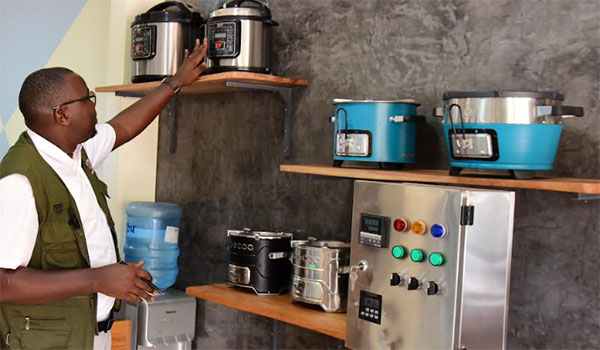
David Ucha showcasing some of the eco-stoves that Detra Environmental Contractors offers
A growing partnership between Equity Bank Uganda, GIZ and local energy company Detra Energy and Environmental Contractors Limited is helping thousands of Ugandan households reduce cooking costs while embracing cleaner and more environmentally friendly technologies.
For years, Jian Namuhenge depended on a traditional charcoal stove, spending nearly Shs80,000 every month on fuel. Today, thanks to an energy-saving cookstove, the same amount of charcoal lasts almost three months.
“The difference has been remarkable,” Namuhenge says. “I now spend much less on charcoal, and the money I save can support other family needs. The stove is easy to use, lights quickly and allows me to control the heat.”
Her experience reflects the impact of a clean cooking initiative being spearheaded by Detra Energy, a Ugandan company that is promoting affordable energy technologies aimed at reducing household fuel consumption and environmental degradation.
Established in 2022, Detra Energy and Environmental Contractors Limited focuses on renewable energy, waste management, water and sanitation services, environmental compliance and sustainable construction solutions. However, its clean cooking programme has emerged as one of its flagship interventions.
Uganda continues to rely heavily on charcoal and firewood for cooking, placing pressure on forests and exposing households to harmful indoor air pollution. To address this challenge, Detra introduced a range of modern cooking technologies that consume less fuel while offering greater convenience and efficiency.
Among its products are electric pressure cookers and fuel-efficient charcoal stoves, including the Digiwave Electric Pressure Cooker series, Biolite Jiko Safi, Biolite Jiko Malkia and the Ecoa range of charcoal-saving cookstoves.
Although many households expressed interest in cleaner cooking alternatives, high upfront costs often limited access.
This changed in 2024 when Detra partnered with Equity Bank Uganda and GIZ through a Results-Based Financing (RBF) programme designed to make clean cooking technologies more affordable.
The programme introduced subsidies that significantly lowered the purchase price of energy-efficient stoves. Products that previously retailed at about Shs140,000 became available for as low as Shs60,000 for many Ugandan households, while refugee and host communities accessed them at subsidised rates of approximately Shs70,000.
According to Equity Bank Uganda’s Head of Energy, Environment and Climate Change, Virginia Semakula, the financing arrangement is helping bridge the affordability gap that has slowed adoption of renewable energy technologies.
“Many Ugandans are interested in clean energy solutions, but the initial investment remains a challenge. Through results-based financing, we are helping households and small businesses access technologies that improve livelihoods while supporting environmental sustainability,” she said.
Detra Energy Director David Ucha says the partnership has been instrumental in expanding the company’s market reach and strengthening consumer confidence.
“Despite being relatively new in the clean cooking sector, Equity Bank Uganda and GIZ trusted us as a partner. Their support has enabled us to reach communities that previously could not afford these technologies and has accelerated our growth,” Ucha said.
Beyond affordability, the technologies are delivering environmental and health benefits. The stoves use significantly less charcoal, produce less smoke and create cleaner cooking environments for households.
For many families, reduced fuel consumption translates into substantial savings that can be redirected to education, healthcare and other essential household expenses.
The wider adoption of clean cooking technologies could also contribute to national efforts to reduce deforestation and promote sustainable natural resource management.
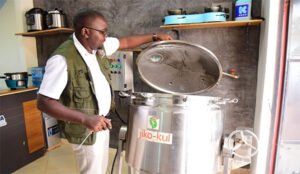
Building on its household energy solutions, Detra is now expanding into institutional cooking technologies. The company recently introduced the Jiko-Kul, a high-capacity pressure cooker designed for schools, hospitals and other large institutions.
The innovation combines electric heating with oil-based heat retention technology, allowing food to continue cooking even after power is switched off. Developers say the system addresses challenges associated with unreliable electricity supply while reducing energy costs and cooking times.
Industry observers say the success of the Detra Energy initiative demonstrates how innovative financing models and strategic partnerships can accelerate Uganda’s transition to cleaner and more sustainable energy solutions.
As demand for affordable and environmentally friendly cooking technologies continues to rise, the partnership between Equity Bank Uganda, GIZ and Detra Energy is increasingly being viewed as a practical model for expanding access to clean energy across the country.











Leave a Reply