


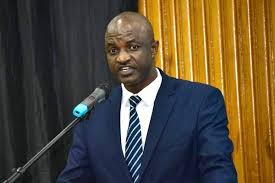
Secretary to Treasury, Ramathan Ggoobi, while appearing before the Public Accounts Committee
Uganda’s public debt has climbed to UGX130.9 trillion, driven largely by increased domestic borrowing, according to the latest figures released by the Ministry of Finance, Planning and Economic Development.
The new data, contained in the Quarterly Debt Statistical Bulletin and Public Debt Portfolio Analysis for December 2025, shows that the country’s total debt stock rose from US$34.21 billion (UGX128.6 trillion) in September 2025 to US$34.86 billion (about UGX130.9 trillion) by the end of December 2025.
According to the report, domestic debt accounted for the largest share, representing 54.5% of the total stock, equivalent to US$19.02 billion (UGX68.86 trillion). External debt stood at 45.3%, equivalent to US$15.84 billion (UGX57.33 trillion).
“The total public debt stock increased to US$34.86 billion by the end of December 2025… This quarterly increase stemmed mainly from increased domestic debt issuances,” the report states.
Despite the rise in overall debt, the Ministry reported a decline in domestic debt servicing costs, which fell by UGX916 billion, from UGX3.913 trillion in September 2025 to UGX2.997 trillion by December 2025.
The debt report comes amid growing debate in Parliament over government borrowing from local commercial banks.
Appearing before the Public Accounts Committee of Parliament on March 11, 2026, the Secretary to the Treasury, Ramathan Ggoobi, dismissed claims by MPs that government borrowing is crowding out private sector access to credit.
Ggoobi argued that government borrowing actually supports private sector participation by providing cheaper financing to citizens through wealth-creation programmes.
“We need to rethink some of these models because in Uganda, government is borrowing on behalf of the private sector,” Ggoobi said.
He cited the Parish Development Model, explaining that government borrows at around 16–17 percent and then lends the money to beneficiaries at zero interest.
“There is no way a PDM beneficiary would have been welcomed in a bank, but government borrows and provides that capital at zero interest. So we are not crowding out the private sector; we are crowding it in,” he said.
However, several MPs challenged the ministry’s position, arguing that heavy domestic borrowing could discourage banks from lending to businesses.
Ignatius Mudimi, MP for Elgon County, noted that although commercial lending rates have fallen from about 22 percent to around 17 percent, government borrowing through treasury bonds still competes for the same pool of capital.
“Financial institutions prefer lending to government because of the lower risk. If we are competing in the same market, what are we doing to support the private sector?” Mudimi asked.
The Vice Chairperson of the committee, Gorreth Namugga, urged the government to balance domestic borrowing with broader access to affordable credit, warning that many small businesses remain excluded from government wealth programmes.
“The biggest percentage of Ugandans are still left out. By leaving them to face high commercial interest rates, we are not helping communities,” Namugga said.
Economists and civil society organisations have also raised concerns about the implications of rising domestic borrowing.
Jane Nalunga, Executive Director of the Southern and Eastern Africa Trade Information and Negotiations Institute (SEATINI Uganda), said the ratio of domestic debt to private sector credit has surged from 169% in FY2023/24 to 252% in FY2024/25.
She noted that this far exceeds the 100% threshold recommended under Uganda’s Public Debt Management Framework, signalling growing reliance on domestic borrowing.
While government programmes such as the Uganda Development Bank, EMYOOGA and the Parish Development Model aim to channel credit to citizens, Nalunga said access to these funds remains limited.
Similarly, Julius Mukunda, Executive Director of the Civil Society Budget Advocacy Group, welcomed the idea of government borrowing to provide cheaper capital but warned that distribution channels remain too narrow.
“If government borrows from commercial banks but cannot reach the intended beneficiaries, then the impact is lost. Either we expand the distribution channels or reconsider the borrowing strategy,” he said.
The government is expected to continue relying on domestic borrowing to finance its budget.
In the Second Budget Call Circular issued on February 13, 2026, the Ministry indicated plans to borrow UGX8.95 trillion domestically to finance the 2026/27 national budget, slightly lower than the UGX11.38 trillion borrowed for the current 2025/26 budget.
The government is also projected to spend UGX9.678 trillion on domestic debt repayment in the 2026/27 financial year, compared to UGX10.027 trillion in refinancing costs for 2025/26.












Leave a Reply