


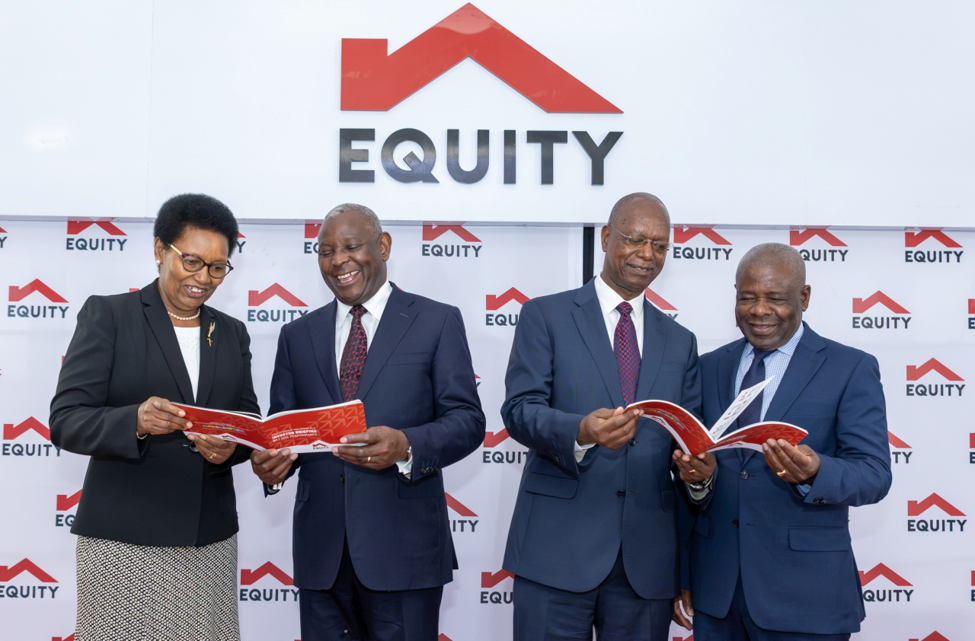
From L-R: Equity Bank Tanzania Non-Executive Director, Evelyn Rutagwenda, Equity Group Managing Director and CEO, Dr. James Mwangi, Equity Group Chairman, Prof. Isaac Macharia, and Equity Group Non-Executive Director, Jonas Mushosho, during the H1 2026 Investor Briefing
Equity Group Holdings Plc has posted a strong financial performance for the first half of 2026, with profit after tax rising 32% to KSh45.5 billion, up from KSh34.6 billion recorded during the same period last year.
The growth, according to the Group, was driven by improved balance sheet quality, stronger contributions from its regional subsidiaries and increased income from non-funded activities.
The Group’s total income grew by 25% to KSh124.9 billion, compared with KSh100.2 billion in the first half of 2025. Net interest income rose 17% to KSh69.3 billion from KSh59.3 billion, reflecting continued growth in lending and disciplined balance sheet management.
Non-funded income recorded a stronger increase, rising 36% to KSh55.6 billion from KSh40.9 billion. It now accounts for 44.5% of total income, up from 40.8% a year earlier.
Equity’s balance sheet expanded by 20% to KSh2.16 trillion, supported by a 21% increase in customer deposits to KSh1.59 trillion and a 19% rise in net loans to KSh981 billion.
Shareholders’ funds also increased by 27% to KSh350 billion, strengthening the Group’s capital position.
The Group said its performance reflects a multi-year transformation agenda focused on resilience, diversification and technology enablement as it continues to expand its pan-African financial services operations.
While releasing the results, Equity Group Managing Director and Chief Executive Officer, Dr James Mwangi, said the performance came against a backdrop of resilient economic growth across the markets where the Group operates.
He cited projected economic growth of 4.5%-5% in Kenya, 5.6% in the Democratic Republic of Congo, 5.9% in Tanzania, 6.4% in Uganda, 6.8% in Rwanda and 20% in South Sudan.
Mwangi said the Group had repositioned its operating model, strengthened its regional presence and invested in digital and artificial intelligence-enabled capabilities.
“We are building a future ready institution; scalable, secure, and impact led, anchored in digital capabilities, staff upskilling, and a culture of disciplined execution,” he said.
Digital banking gains
The Group’s digital transformation continued to reshape customer engagement, with 98.3% of all transactions taking place outside branches and 89.7% processed through digital platforms.
Equity currently serves 23.3 million customers through its digital and physical channels, including Equity Online, Eazzy FX, the Equity Mobile App, *247# and Equitel.
Its distribution network comprises 410 branches, 886 ATMs, 92,572 agency outlets and 1.4 million merchants.
The Group said the shift towards digital channels had also contributed to improved operational efficiency, with its cost-to-income ratio falling to 48.6% from 51.7%.
Return on assets stood at 4.5%, while return on equity reached 26.5%.
The technology drive has also extended to staff development. The Group reported that 82% of its staff had completed a business-focused generative AI course, while 55% had completed two additional courses through the Huawei ICT Academy.
Staff collectively completed 119,980 hours of guided AI instruction, while 406 employees were admitted to Master’s degree programmes in Financial Engineering and Applied AI through WorldQuant University.
Regional operations strengthen
Equity’s regional subsidiaries continued to make a significant contribution to the Group’s performance. The subsidiaries now account for 42% of Group banking profitability and 52% of banking revenue. They also contribute 51% of Group deposits, 54% of loans and 52% of banking assets.
Equity BCDC in the Democratic Republic of Congo recorded a 30% increase in profit after tax to KSh11.8 billion, while Equity Rwanda’s profit after tax rose 12% to KSh2.9 billion.
Equity Tanzania posted the strongest growth among the highlighted regional operations, with profit after tax increasing 82% to KSh2 billion.
In Kenya, Equity Bank’s profit after tax rose 32% to KSh25.7 billion from KSh19.5 billion. Its assets grew by 13%, supported by a 24% increase in deposits and an 8% rise in loans.
The bank also maintained its position in the micro, small and medium enterprise segment, disbursing 36% of the KSh101 billion in MSME loans issued in Kenya between January and March 2026.
Insurance and non-banking businesses
Equity Insurance Group also recorded growth during the period, with gross written premiums increasing 24% to KSh6.4 billion, while profit before tax rose 34% to KSh1.25 billion.
The life and general insurance businesses wrote KSh4.5 billion and KSh0.6 billion respectively, while the health insurance business generated KSh1.2 billion in gross written premiums.
The number of life insurance policies issued increased to 22.6 million, while 7.2 million unique customers consumed life insurance products. A further 24,745 MSMEs accessed general insurance covers.
Digital distribution accounted for 79% of the insurance policies issued, highlighting the growing role of technology in the Group’s diversification strategy.
The Group’s non-banking subsidiaries also increased their contribution to revenue, accounting for 4.8%, up from 4%. Their contribution to profit before tax rose to 4.2% from 3.8%, while profit after tax contribution increased to 3.7% from 3.2%.
Asset quality improves
Equity said its risk buffers and asset quality also improved during the period.
Non-performing loan coverage increased to 70% from 68%, while loan-loss provisions declined by 6% year-on-year.
The ratio of non-performing loans to the loan book improved from 13.7% to 9.5%, which the Group attributed to disciplined underwriting, improved analytics and portfolio diversification.
Cost of risk also improved to 1.4% from 1.7%.
Foundation expands social impact
Beyond its financial services operations, the Equity Group Foundation continued to expand its education, enterprise development, agriculture, climate and technology programmes across Africa.
The Foundation currently supports more than 11,663 active high-school scholars and secured 121 new global university admissions in 2026, valued at USD23.42 million.
Through the Wings to Fly and Elimu scholarship programmes, the Foundation has so far benefited 60,009 scholars, while the Equity Leaders Programme has surpassed 10,505 cumulative paid internships.
More than 35,300 scholars have transitioned to public universities across Kenya, Rwanda, Uganda and the Democratic Republic of Congo.
In enterprise development and financial inclusion, the Foundation has trained more than one million entrepreneurs and facilitated over KSh436 billion in credit access to MSMEs.
Its agricultural programmes include the USD25 million SASTAIN programme, implemented in partnership with the Mastercard Foundation and targeting 60,000 smallholder farmers and agri-MSMEs in Tanzania and the Democratic Republic of Congo.
The Foundation has also planted more than 48.7 million trees as part of its environmental and climate action programmes.
Equity Group’s accreditation as a Direct Access Entity to the Green Climate Fund is expected to strengthen its ability to mobilise climate finance for programmes covering climate-smart agriculture, renewable energy, nature restoration, green enterprise development and community resilience.
The Group said it remains well positioned to pursue its 2030 strategy under the Africa Recovery and Resilience Plan.
The strategy seeks to expand operations to 15 countries, serve 100 million customers and deploy next-generation digital and AI-enabled systems to scale transformation finance across Africa.
Mwangi said the Group was evolving beyond traditional banking into an integrated, technology-enabled financial institution capable of mobilising capital, connecting ecosystems and supporting inclusive and sustainable prosperity across the continent.
The first-half performance, he said, demonstrates the progress made in building a diversified and technology-enabled institution while strengthening the Group’s capacity for future growth.







Leave a Reply