


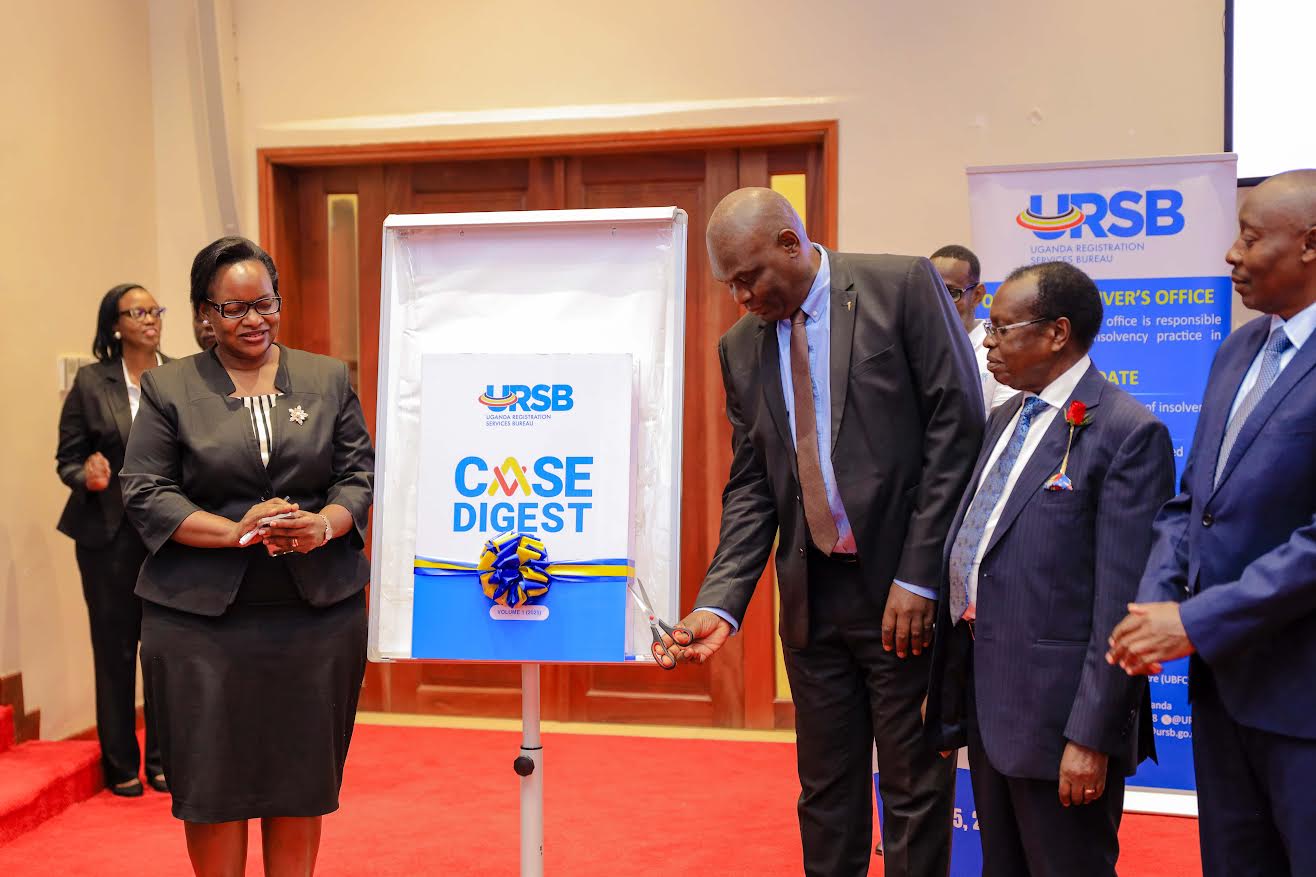
The Uganda Registration Services Bureau (URSB) is positioning its quasi-judicial and alternative dispute resolution (ADR) mechanisms as an important tool for reducing costly commercial disputes and strengthening confidence in Uganda’s business environment.
The Bureau says its ability to resolve disputes involving company ownership, shareholding, governance, intellectual property and other commercial matters is helping businesses access relatively affordable and efficient avenues for justice outside the traditional court process.
The role is highlighted in the newly published URSB Case Digest, Volume II, 2026, which compiles selected decisions of the Registrar alongside relevant court rulings.
The second edition provides businesses, legal practitioners, regulators and other stakeholders with practical guidance on how laws administered by URSB are interpreted and applied.
URSB Board Chairman Francis K. Butagira said effective institutions are essential to maintaining a conducive business environment, particularly where commercial disputes can affect business operations and investor interests.
“Through the Registrar’s quasi-judicial function, the Bureau continues to provide an accessible and efficient mechanism for resolving disputes, correcting registry irregularities, and protecting the legitimate interests of both businesses and the public,” Butagira said.
He said the decisions contained in the Case Digest demonstrate URSB’s commitment to maintaining accurate and reliable registers while ensuring that commercial disputes are handled fairly and transparently.
According to URSB, timely resolution of commercial disputes is increasingly important in maintaining business continuity and strengthening investor confidence.
Registrar General Mercy K. Kainobwisho said disputes involving intellectual property ownership, company shareholding and management, governance and membership can have significant economic consequences when left unresolved.
“Through the quasi-judicial powers of the Registrar under the relevant laws, URSB provides an accessible, affordable and efficient forum for dispute resolution,” Kainobwisho said.
She said the Bureau has adopted alternative dispute resolution and other administrative mechanisms aimed at helping parties settle disputes more efficiently while reducing the time and costs associated with litigation.
The Case Digest also seeks to promote consistency, transparency and predictability in the application of commercial laws.
By making selected decisions available to the public, URSB said the publication will support legal research and enable businesses and practitioners to identify emerging trends in areas such as corporate governance, regulatory compliance, insolvency and intellectual property protection.
The cases featured in the second edition illustrate the practical scope of the Registrar’s quasi-judicial powers. They cover matters including shareholder disputes, unlawful share transfers, company governance, rectification of company registers and minority oppression.
In one of the cases highlighted, the Registrar ordered the rectification of a company register after determining that documents purportedly appointing a director and allotting shares had not been validly authorised.


















Leave a Reply