


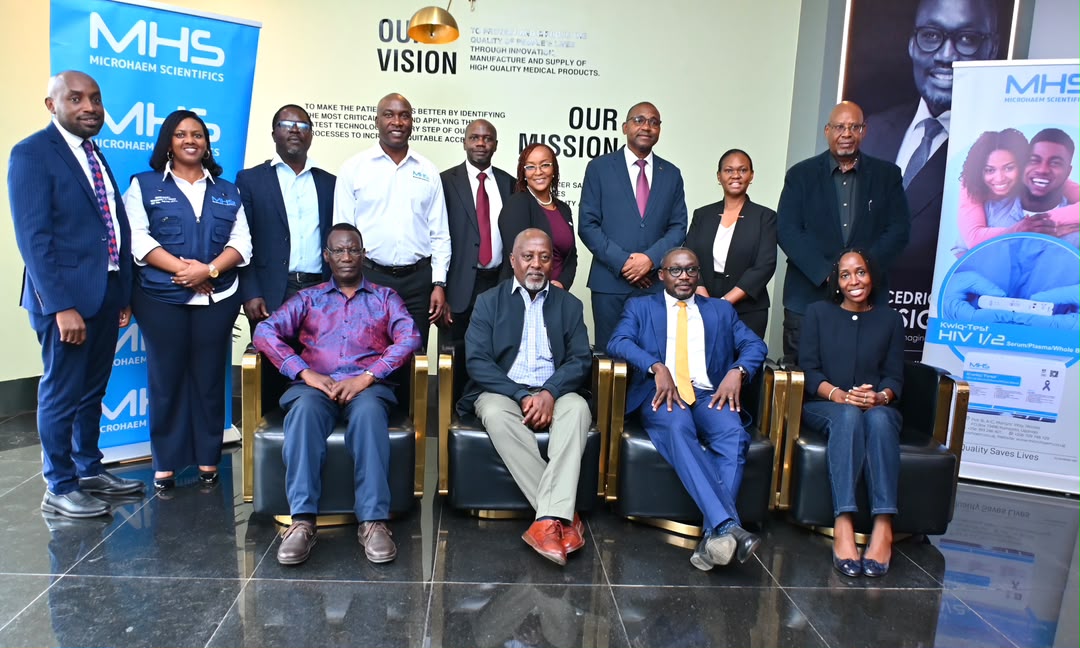
In the photo: Equity Bank Uganda Board Chair Henry Rugamba, Managing Director Gift Shoko, senior executives, and members of the Microhaem Scientific team during a visit to the company’s facility in Ntinda.
On the morning of 7 August 2026, Equity Bank Uganda’s Board Committee, led by Board Chair
Henry Rugamba and accompanied by Managing Director Gift Shoko and senior executives,
conducted a strategic engagement and guided facility tour at Microhaem Scientifics (MHS). The visit
covered both the active production site in Ntinda, Kampala, and the 20-acre Phase II expansion under
construction at Namanve Industrial Park.
The engagement reaffirmed Equity Bank Uganda’s role as the primary financier of Microhaem’s
growth. To date the bank has committed more than USD 50 million in facilities that have enabled the
company to scale manufacturing capacity, strengthen quality systems, and move decisively toward
reducing Uganda’s dependence on imported diagnostics and pharmaceuticals.
Microhaem Scientifics was founded by Ugandan scientist Dr. Cedric Akwesigye with a clear
conviction: Africa’s health security cannot rest on supply chains that stretch across oceans. For years
the continent’s clinics and hospitals relied almost entirely on imported test kits and medicines,
products that frequently arrived late, degraded in tropical heat, or failed to match local disease
patterns. Dr. Akwesigye set out to reverse that vulnerability from within.
Operating under the philosophy “Quality Saves Lives,” the company began by designing diagnostic
tools specifically engineered for East African realities. Its flagship Pf-Xpat malaria rapid diagnostic test
kits are moisture-resistant and remain stable at temperatures up to 40 °C, critical for remote health
centres that lack reliable refrigeration. Parallel lines for HIV (Kwiq Test), sickle-cell screening
(MicroScreen), and molecular reagents followed.
These products now address some of the region’s heaviest disease burdens: Uganda ranks third
globally in malaria cases (5 % of the world total, incidence 60.4 per 1,000), records an estimated
20,000 new sickle-cell births each year (with 70–80 % of affected children dying before age five
without early detection), and continues to strengthen its HIV testing algorithm toward the UNAIDS
“first 90” target.
From a modest start in Ntinda, Microhaem has grown into one of East Africa’s leading indigenous
manufacturers of in-vitro diagnostics. Phase I production continues to supply national programmes
and private providers. Phase II at Namanve, a purpose-built complex featuring a four-level
manufacturing block (40 m × 160 m), dedicated utility systems, a plastics factory for syringes and
consumables, R&D floors, and specialist accommodation, will dramatically expand capacity for both
diagnostics and wider pharmaceutical lines. Civil works on the main block are due for completion by
December 2026, followed by a year of GMP fit-out, with first validated products expected within
approximately 18 months.
In his remarks, Henry Rugamba, Board Chair, Equity Bank Uganda, reflected on the journey Equity
Bank Uganda took to support local manufacturers with ambitious Pan-African dreams:
“What we saw today is African capability in action. Microhaem is not waiting for solutions to be shipped from elsewhere; it is building them here. Equity Bank is proud to have financed this journey with over USD 50 million to date. Local manufacturers, backed by local capital, are the surest route to health sovereignty and economic resilience.”
On his part, Gift Shoko, Managing Director, Equity Bank Uganda, lent his voice to the banks mandate
on the Africa Recovery and Resilience Plan: “Through our Africa Recovery and Resilience Plan we
deliberately channel capital into industries that reduce import dependence and create skilled jobs.
Supporting Microhaem Scientifics is a clear expression of that strategy. We are not merely lenders;
we are partners in building the industrial backbone Uganda and East Africa need.”
Equity Bank Uganda’s support sits within Equity Group’s Africa Recovery and Resilience Plan
(ARRP), a USD 6 billion continental strategy that targets private-sector growth, industrialisation,
cross-border value chains and financial inclusion for up to 100 million customers by 2030.
Manufacturing and logistics form a core pillar of the plan, making projects such as Microhaem a
natural fit.
Dr. Cedric Akwesigye, Founder & Managing Director, Microhaem Scientifics, spoke in appreciation of Equity Bank Uganda’s support to their Pan-African vision:
“Fourteen years of rigorous development, testing and iteration have brought us to this point. Equity Bank’s confidence and sustained financing have been decisive. Our goal remains simple: to protect and improve the quality of people’s lives through the innovation, manufacture and supply of high-quality medical products made in Uganda, for Uganda, and for export across Africa.”
The visit concluded with a shared understanding that the partnership will continue to deepen as
Phase II comes on stream. Together, Equity Bank Uganda and Microhaem Scientifics are converting
the long-standing ambition of medical import substitution into concrete capacity, one locally
manufactured, life-saving product at a time.








Leave a Reply