


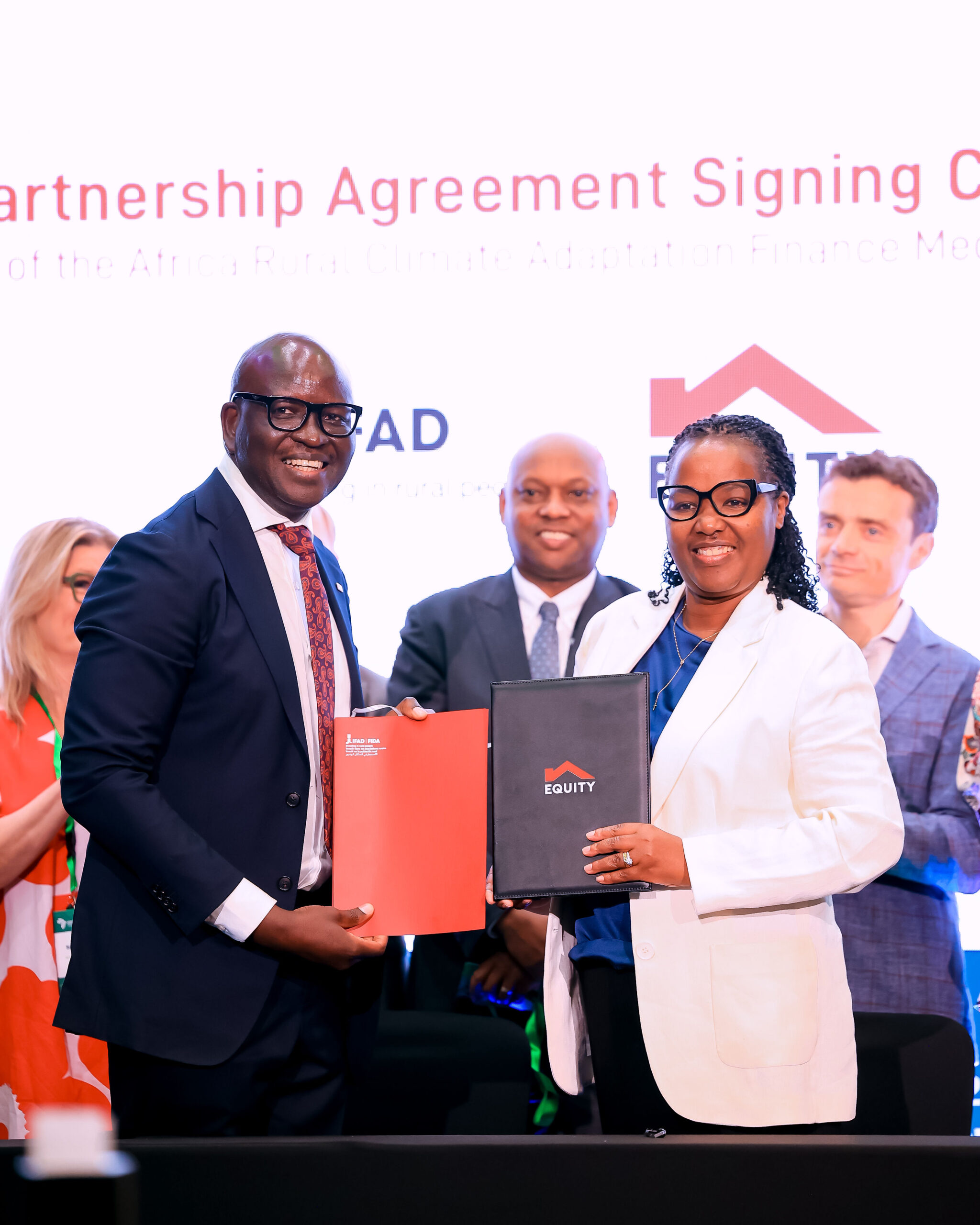
L-R Equity Bank Kenya Managing Director, Moses Nyabanda, and Dr. Gérardine Mukeshimana, IFAD Vice President, during the signing ceremony of the Africa Rural Climate Adaptation Finance Mechanism
KIGALI, Rwanda, September 8, 2026 — The International Fund for Agricultural Development (IFAD) and Equity Group have launched a US$200 million financing mechanism aimed at expanding access to climate adaptation finance for smallholder farmers and rural businesses in East Africa.
The Africa Rural Climate Adaptation Finance Mechanism (ARCAFIM), launched at the Africa Food Systems Forum 2026 in Kigali, will provide financing to farmers and rural enterprises in Kenya, Uganda, Tanzania and Rwanda over a 12-year period.
The initiative is targeting about 260,000 smallholder producers and 500 rural micro, small and medium-sized enterprises (MSMEs), with women expected to account for at least 50 per cent of beneficiaries and youth 30 per cent.
At the centre of the financing model is a US$180 million lending facility, alongside about US$20 million in technical assistance.
Equity Group will contribute US$90 million from its own balance sheet, matching the concessional financing on a one-for-one basis.
The lending capital is expected to revolve through roughly four investment cycles, generating about US$266 million in loans to smallholder farmers and MSMEs operating across East Africa’s food systems.
The model is designed to reduce the risks associated with lending to rural businesses and farmers, while encouraging commercial financial institutions to treat climate adaptation as a viable banking business rather than relying solely on development funding.
Under the risk-sharing structure, international financing partners will cover the first-loss portion of the portfolio, a mezzanine layer will be shared with Equity Group, while the bank will carry the senior risk.
Dr Gérardine Mukeshimana, Vice President of IFAD, said the mechanism is intended to turn climate adaptation finance into a sustainable business line for African financial institutions.
“ARCAFIM’s ambition is to make rural climate adaptation a recognizable, viable and sustainable business line for African financial institutions,” she said.
Mukeshimana said the mechanism would provide financial institutions with the systems, experience and confidence needed to expand climate adaptation lending beyond the programme.
The technical assistance component will support microfinance institutions and savings and credit cooperative organisations (SACCOs) to develop and provide adaptation financing. Farmers and rural enterprises will also receive technical support to identify investments that can strengthen their resilience.
These investments will include irrigation and water harvesting, dairy and livestock resilience, post-harvest storage, renewable energy and climate-resilient agro-processing.
Equity Group Managing Director and Chief Executive Officer Dr James Mwangi said the bank’s contribution of its own capital demonstrates its confidence in the commercial potential of rural climate finance.
“By committing our own balance sheet alongside concessional capital, we are not funding a project — we are building a market,” Mwangi said.
He said the initiative is intended to make lending for climate resilience an ordinary banking activity and improve the perception of smallholder farmers as bankable customers.
Moses Nyabanda, Managing Director of Equity Bank Kenya, said the bank would provide financing directly to farmers and agricultural producers, as well as through microfinance institutions, SACCOs and value-chain companies.
The bank will also finance rural MSMEs while supporting borrowers to adopt sustainable agricultural practices and technologies.
The Green Climate Fund (GCF) has committed US$55 million to the mechanism.
Catherine Koffman, Director of the Department of Africa Region at GCF, said its contribution would help mobilise commercial investment from Equity Group and expand access to adaptation finance across East Africa.
ARCAFIM is being implemented with co-financiers of the Green Climate Fund, the Ministry for Foreign Affairs of Finland and the Nordic Development Fund, and is also co-financed by the Government of Denmark and the European Union.
The programme is expected to strengthen food security for about 1.2 million people and benefit an estimated 1.5 million people directly and indirectly.
For Equity Group and its partners, however, the longer-term measure of success will be whether climate adaptation lending can continue commercially after the concessional capital has been deployed.
The partners intend to use lessons from the East African programme to develop similar blended-finance models in other parts of Africa. Southern and West Africa have been identified as potential next regions for expansion.
The launch brought together representatives from IFAD, Equity Group, governments of Kenya, Uganda, Tanzania and Rwanda, private-sector investors, development partners and climate finance institutions.
The agreements were signed by Mukeshimana on behalf of IFAD and Nyabanda for Equity Bank Kenya in a ceremony presided over by Hannington Namara, Managing Director of Equity Bank Rwanda.








Leave a Reply