


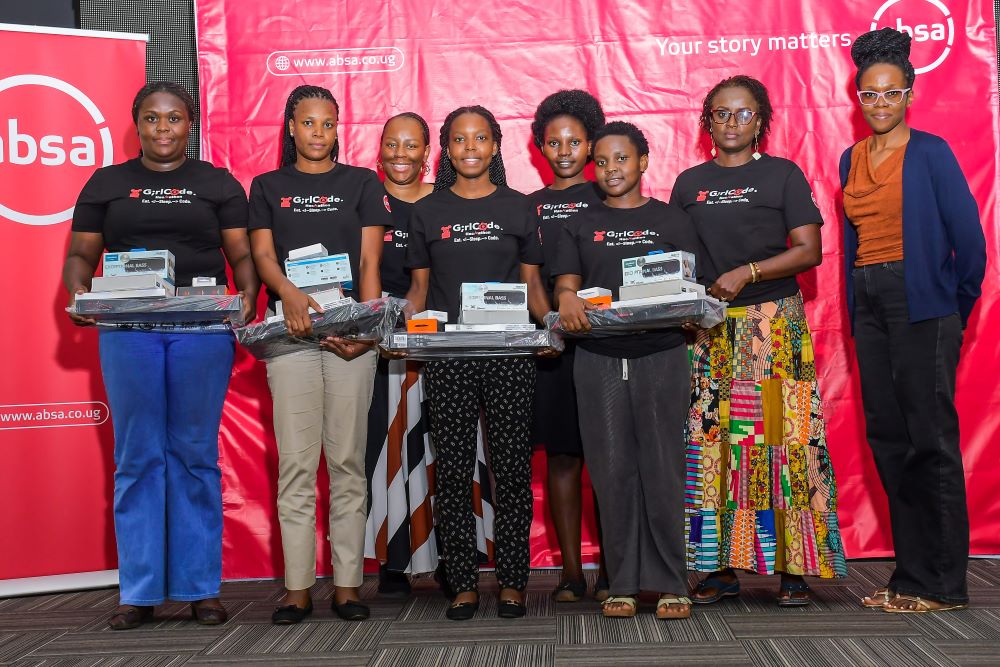
KAMPALA — Team HerTECH has won the second edition of the GirlCode Uganda Hackathon and will represent Uganda at the continental competition, where it will compete for a USD 6,000 prize.
The team emerged top after developing a digital solution aimed at helping small traders overcome challenges associated with record-keeping and financial management, highlighting the growing role of women-led technology businesses in addressing gaps in Uganda’s financial sector.
The 30-hour competition, held over the weekend at the National ICT Innovation Hub in Nakawa, brought together 61 female developers, designers and technology entrepreneurs to develop digital products addressing challenges affecting women’s economic participation.
The hackathon was organised by Absa Bank Uganda in partnership with the pan-African GirlCode initiative and the National ICT Innovation Hub, with this year’s competition focusing on artificial intelligence (AI), financial technology (fintech) and women’s economic empowerment.
Participants developed solutions addressing financial literacy, digital payments, access to credit and agricultural inclusion, areas that remain important for expanding financial participation among women, particularly those operating small and informal businesses.
Team HerTECH — comprising Boonabaana Bronia, Nabaloga Sanyu Eleanor, Muteesasira Tendo Shamma and Akatukunda Precious Praise — won with DuukaTalk, a voice-first digital ledger designed to enable vendors to record business transactions using voice commands in English or Luganda.
The team said the solution is intended to address accounting and record-keeping barriers faced by small traders who may have limited financial or digital literacy.
By allowing users to record transactions through voice rather than relying on written entries, the technology could make basic financial management more accessible to informal businesses.
The solution also demonstrates how local-language technology can be applied to everyday business challenges, particularly among micro and small enterprises that may not have sophisticated accounting systems.
Team CropXcel emerged first runner-up with an AI-powered platform that uses soil data, weather forecasts and location information to provide farmers with recommendations on planting schedules, projected yields, market prices and potential sales outlets.
The solution seeks to use data and artificial intelligence to help farmers make decisions that can improve production and market access.
Team Sphinx was named second runner-up with Second Life, an application connecting households with local artisans to facilitate the upcycling of unused items.
The three teams received prizes including laptops, Bluetooth speakers, headphones and other accessories.
Team HerTECH will now advance to the Africa-wide finals, where it will compete against teams from five other African countries for the USD 6,000 prize.
Banking industry backs women in technology
For Absa Bank Uganda, the hackathon also provides an avenue for the financial sector to identify technology solutions that could influence the development of future financial products and services.
Robinah Mukasa Kamuntu, acting marketing and consumer experience director at Absa Bank Uganda, said increasing the participation of women in technology was important to the development of financial solutions that respond to the needs of customers.
“As a bank driven by technology, closing the gender technology gap is about ensuring the people building the financial solutions of tomorrow reflect the customers and communities we serve,” she said.
The emphasis on fintech is significant for banks and other financial institutions as digital technologies increasingly influence how customers access payments, savings, credit and other financial services.
The competition therefore brought together two areas of growing importance to Uganda’s economy — the expansion of digital financial services and the participation of women in technology and entrepreneurship.
From participation to enterprise
Zandile Mkwanazi, co-founder and chief executive of GirlCode, said women need to play a central role as Uganda’s digital economy expands.
“Uganda has a growing community of young innovators, and it is important that women are not left behind as the country’s digital economy expands,” she said.
Mkwanazi said the National ICT Innovation Hub and MTN Uganda had joined the programme as partners this year.
Carol Kagezi, partnerships and alliances coordinator at the National ICT Innovation Hub, said the focus should go beyond giving women access to technology events and training.
“We want more women to participate meaningfully in Uganda’s innovation ecosystem: not only by attending tech events, but by building enterprises, leading teams, and creating solutions that respond to national priorities,” she said.
This shift from participation to enterprise development is particularly important for Uganda’s technology ecosystem, where innovators continue to look for ways to turn digital ideas into commercially viable products and businesses.
Organisers said the hackathon also sought to address challenges surrounding women’s access to finance.
World Bank Findex data shows that formal account ownership in Uganda reached 73 per cent in 2025, although rural women and informal traders continue to face barriers to credit and access to formal financial-management tools.
The gap presents both a challenge and an opportunity for financial institutions and technology companies.
Digital solutions that improve record-keeping, financial literacy and transaction histories could help small businesses build information that can potentially support their engagement with formal financial services.
For agricultural businesses, technologies such as CropXcel could also help address information gaps around production, weather, markets and sales, which influence the ability of farmers to make investment and financing decisions.
The hackathon therefore reflects a wider push to use technology not only to create digital products, but also to tackle practical constraints facing women entrepreneurs, farmers and small businesses.
As Team HerTECH prepares for the continental competition, its success places Uganda’s growing community of women technology innovators on a wider African platform and demonstrates the potential for locally developed digital solutions to address financial and economic challenges.
The organisers said the programme is intended to encourage more women to develop solutions, build enterprises and participate in Uganda’s expanding digital economy.
















Leave a Reply