


Justice and Constitutional Affairs Minister, Norbert Mao, has challenged Uganda’s insurance professionals to actively influence public policy and drive the implementation of the proposed National Health Insurance Scheme (NHIS), warning that technical knowledge alone will not expand financial protection for ordinary citizens.
Speaking Thursday at the 6th International Insurance Conference, organized by the Insurance Training College (ITC) at the Acholi Inn in Gulu City, Mao said the industry must move beyond corporate boardrooms and engage directly with key government decision-makers.
“People don’t have money. Insurance companies have money. They have the resources and the capacity. That is why the industry must take the lead and push for a National Health Insurance Scheme that can work for ordinary Ugandans,” Mao said.
He urged insurers to prepare clear, data-driven policy proposals and persistently lobby parliamentary committees and other key state actors for the legislative and regulatory reforms needed to expand coverage.
Mao argued that a well-designed national health insurance framework is essential to protect households from catastrophic out-of-pocket medical expenses that often push families into poverty. He pledged his ministry’s support in facilitating direct engagement between the insurance sector, the Ministry of Justice and Constitutional Affairs, and Parliament.
Mao’s argument is rooted in Uganda’s long and uneven journey toward universal health coverage. Parliament has over the past decade discussed the NHIS, recognizing that high out-of-pocket medical spending remains a primary driver of household poverty.
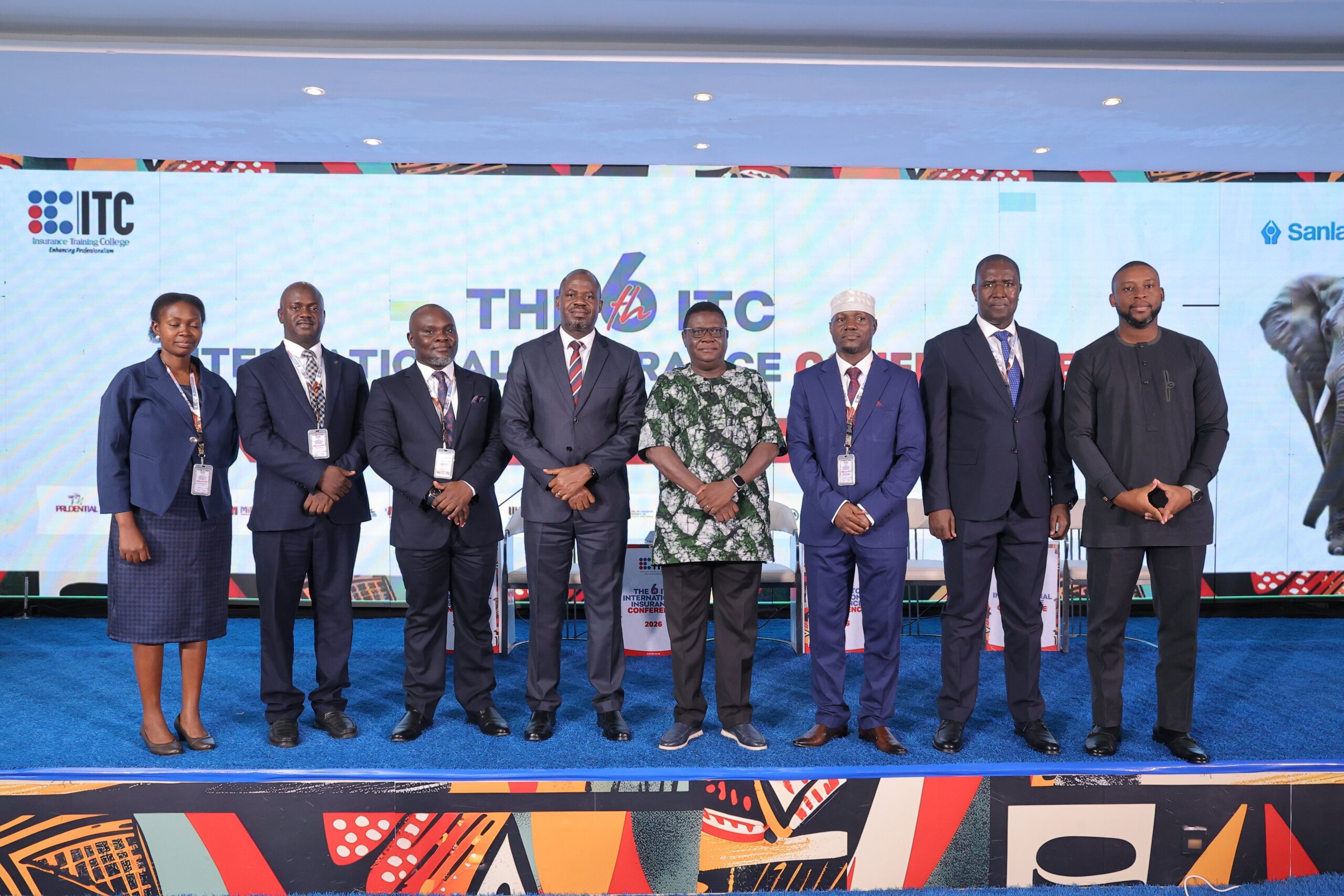
 Dr. Sande Protazio, Chief Executive Officer, IRA, Justice and Constitutional Affairs Minister, Norbert Mao, Board Chairperson, Dr. Abdul Hafiz Walusimbi and Saul Sseremba- Principal/CEO ITC
Mao said progress has been slow, hampered by unresolved questions over sustainable financing models, the dominance of the informal sector, benefit structure designs, and the precise role of private underwriters. Without stronger political pressure and workable operational models from the industry itself, Mao suggested, the scheme risks remaining stuck in policy papers.
Drawing on his political experience during the conflict in northern Uganda, Mao recalled how several major policy proposals were initially rejected by the government before eventually becoming law.
“Successful people don’t think about the joy of doing things, but they think about the joy of achieving,” he told delegates, encouraging professionals not to be discouraged by legislative delays.
The conference came at a time when Uganda’s insurance sector is reporting historic growth, with Gross Written Premiums crossing the Sh2 trillion mark. However, national insurance penetration remains below 1% of Gross Domestic Product (GDP), leaving millions of informal sector workers such as boda-boda riders, market vendors, and smallholder farmers exposed to unexpected financial shocks.
ITC Chief Executive Officer, Saul Sseremba, emphasized that strong premium performance must translate into wider public protection.
“Much as the premiums we collect have now exceeded Sh2 trillion, we still have a big opportunity because there are many people that have not yet been insured,” Sseremba said.
He explained that holding the conference in Gulu, alongside a public exhibition called the Insurance Baraza, was intended to decentralize financial literacy and gather direct feedback from regional micro-enterprises and informal traders.
Sseremba also called for increased government subsidies under the Uganda Agriculture Insurance Scheme and faster progress on legislation supporting low-cost microinsurance and digital distribution channels.
 ITC Chief Executive Officer, Saul Sseremba
Prof. Abdul Hafiz Walusimbi, Chairman of the ITC Governing Council, challenged insurance executives to redefine how they measure industry progress and success.
“Growth in premiums is not the same as growth in protection. The industry can report higher figures, but that does not mean more people are actually covered. Real progress is when ordinary Ugandans are protected against financial shocks,” Prof. Walusimbi said.
He emphasized that public trust depends on transparent product explanations, fair treatment of clients, and prompt settlement of legitimate claims.
Prof. Walusimbi commended President Yoweri Museveni for maintaining a stable macroeconomic, legal, and regulatory environment that has enabled the sector to expand. He affirmed that the college remains committed to research, continuous professional development, and innovation to help the industry underwrite emerging risks, including cyber threats, artificial intelligence disruptions, and climate variability.
The three-day conference, held under the theme “From Risk to Readiness: Navigating Evolving Insurance Trends,” brought together more than 250 local and international delegates, regulators, and financial experts.
















Leave a Reply