


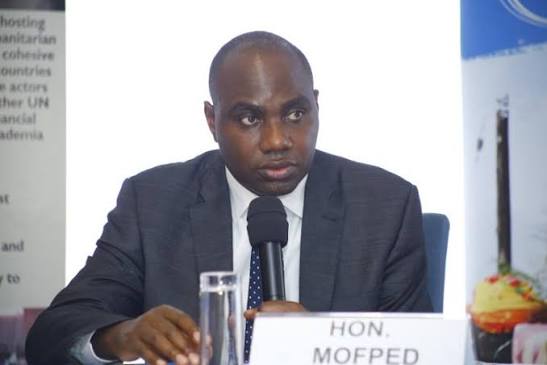
Finance Minister Henry Musasizi has tasked the Uganda National Oil Company (UNOC) Board to explore innovative and sustainable financing options to strengthen the company’s operations and reduce its dependence on direct government budgetary support.
Musasizi, together with Minister of State for Finance Amos Lugoloobi and Minister of State for Energy Cissy Mulondo, made the call during an engagement with the UNOC Board, as Uganda accelerates preparations for first oil.
The Finance Minister commended UNOC for maintaining a stable petroleum supply despite geopolitical tensions and conflicts in major oil-producing regions.
He, however, questioned the significant variations in pump prices across the country, citing differences between prices in Kabale, Masaka, Mbarara and Kampala.
Musasizi said the company must increasingly develop financing models that allow it to operate sustainably while delivering greater value to the economy.
“We need to explore innovative and sustainable financing options that will strengthen UNOC and reduce its reliance on budgetary support,” Musasizi said.
UNOC reported significant progress in the country’s oil and gas developments, with the East African Crude Oil Pipeline (EACOP) standing at 89.4 percent completion, the Kingfisher project at 79.36 percent and Tilenga at 74.2 percent by the end of June 2026.
As Uganda moves closer to first oil, UNOC said it expects to meet cash-call obligations of about US$72 million, increasing the need for reliable and sustainable financing.
The company’s sole-importation business has also expanded, with petroleum imports increasing by 39 percent. UNOC currently supplies 36 oil marketing companies.
Its gross margins increased from Shs387 billion to Shs540 billion in the 2025/26 financial year, reflecting increased activity in the petroleum supply business.
Under a US$2 billion financing facility with Vitol Bahrain, UNOC has so far received US$150 million, while Shs536 billion has been transferred to the Ministry of Finance.
The company is also investing in strategic petroleum infrastructure, including the 320-million-litre Kampala Storage Terminal, a 110-million-litre storage terminal in Mombasa, and plans for a 60,000-barrel-per-day refinery.
At Kabalega Industrial Park, UNOC is developing Phase One infrastructure, with Shs37.96 billion already secured for the project.
UNOC told the ministers that it is working towards a sustainable self-financing model, pointing to its sole-importation operations, which generate approximately US$3 million per month in administrative charges.
The company said increased financial independence would allow it to expand its operations and investments, although continued government capitalisation remains important to unlocking its full potential. The engagement comes as Government seeks to position UNOC as a commercially viable national oil company capable of supporting Uganda’s petroleum sector and retaining a greater share of the value generated from the country’s oil resources.
With first oil approaching, the Government is increasingly focused on ensuring that UNOC has the financial capacity to participate effectively across the petroleum value chain while limiting pressure on the national budget.



Leave a Reply