



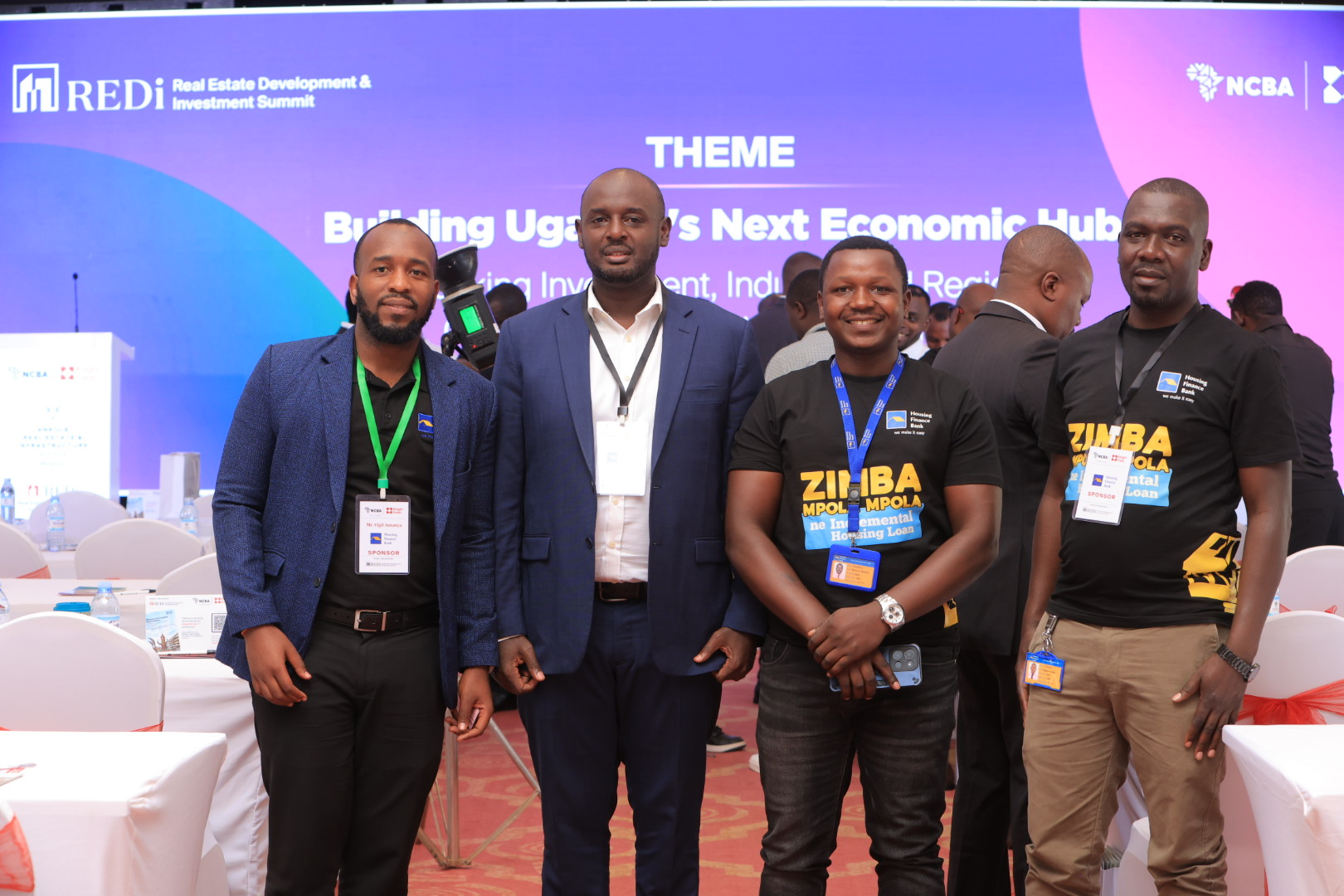
Partners pose for a group photo at the reccent concluded Acholi Real Estate and Infrastructure Conference held at the Acholi Inn Hotel in Gulu
As Uganda’s newly created secondary cities continue to expand, attention is increasingly
shifting from simply recognizing their economic potential to finding practical ways to finance
the infrastructure and housing needed to sustain that growth. This conversation took center stage at the Acholi Real Estate and Infrastructure Conference held at the Acholi Inn Hotel in Gulu organized by Knight Frank Uganda, through its REDi (Real Estate Development and Investment Summit) initiative. The conference brought together developers, financiers, urban planners, and real estate stakeholders with focus discussions on how regional cities can attract investment and deliver sustainable urban
development outside Kampala. Housing Finance Bank participated in the conference reinforcing its commitment to expanding access to housing finance and supporting planned urban growth in Uganda’s
secondary cities. The Bank’s participation aligns with its broader agenda of addressing
Uganda’s housing deficit by developing practical, inclusive financing solutions tailored to how
Ugandans build and invest particularly in emerging regional markets.
Speaking during a panel discussion on financing and project delivery in regional markets,
Hellen Musubika, Acting Head of Mortgage and Consumer Banking at Housing Finance
Bank, emphasized that solving the housing challenge requires moving beyond traditional
lending models.
“Many families build homes gradually depending on their income flow and this why Housing
Finance Bank has innovated products like Zimba Mpola Mpola – an incremental housing loan
that allows customers to finance construction in phases rather than take on a single large
mortgage upfront.” she noted.
Setting the tone for the discussions, Knight Frank Uganda Managing Director Judy
Rugasira highlighted Gulu’s readiness for investment.
“Gulu is open for business. It is a city that’s on the move, a city that is ready and very inviting
for whoever is interested in investing,” said Knight Frank Uganda Managing Director Judy
Rugasira.
Rugasira noted that Knight Frank’s recommendations are grounded in extensive field
research conducted across the region.
“At Knight Frank, we believe in data-backed research. We spent time in Gulu, Nwoya, and
Kitgum mapping the market to understand demand, supply, and investment opportunities,”
she said.
Public
According to findings shared at the conference, sectors such as logistics, warehousing, cold-
chain storage, residential housing, student accommodation, and hospitality present strong
investment potential in Gulu and the wider region.
“The momentum of growth in secondary cities like Gulu is undeniable, and their long-term
success hinges on prioritizing planned, sustainable urban development now. It is crucial that
the financing sector and city planners work in coordination to meet the rising demand for
organized housing and supporting infrastructure,” noted Knight Frank Head of Research,
Hillary Mbaihayo
From a policy perspective, Government reaffirmed the importance of collaboration in driving
national development outcomes. Joseph Enyimu, Commissioner for Economic
Development Policy and Research at the Ministry of Finance, Planning and Economic
Development, emphasized the need for coordinated action.
“As part of the 500-billion-dollar economy that government is building, we need goal
consensus bringing together different players to see the same outcome and I think this’s
conference has served that purpose,” Enyimu said.
Despite strong investment potential in regional markets, stakeholders identified access to
financing as a key constraint to planned urban growth. Housing Finance Bank reaffirmed its
role in closing this gap by advancing practical, inclusive solutions tailored to real market
needs.
The Bank emphasized that scaling innovative models such as “Zimba Mpola Mpola,”
alongside stronger public-private collaboration, will be critical to unlocking structured and
sustainable urban development across Uganda’s secondary cities











Leave a Reply