


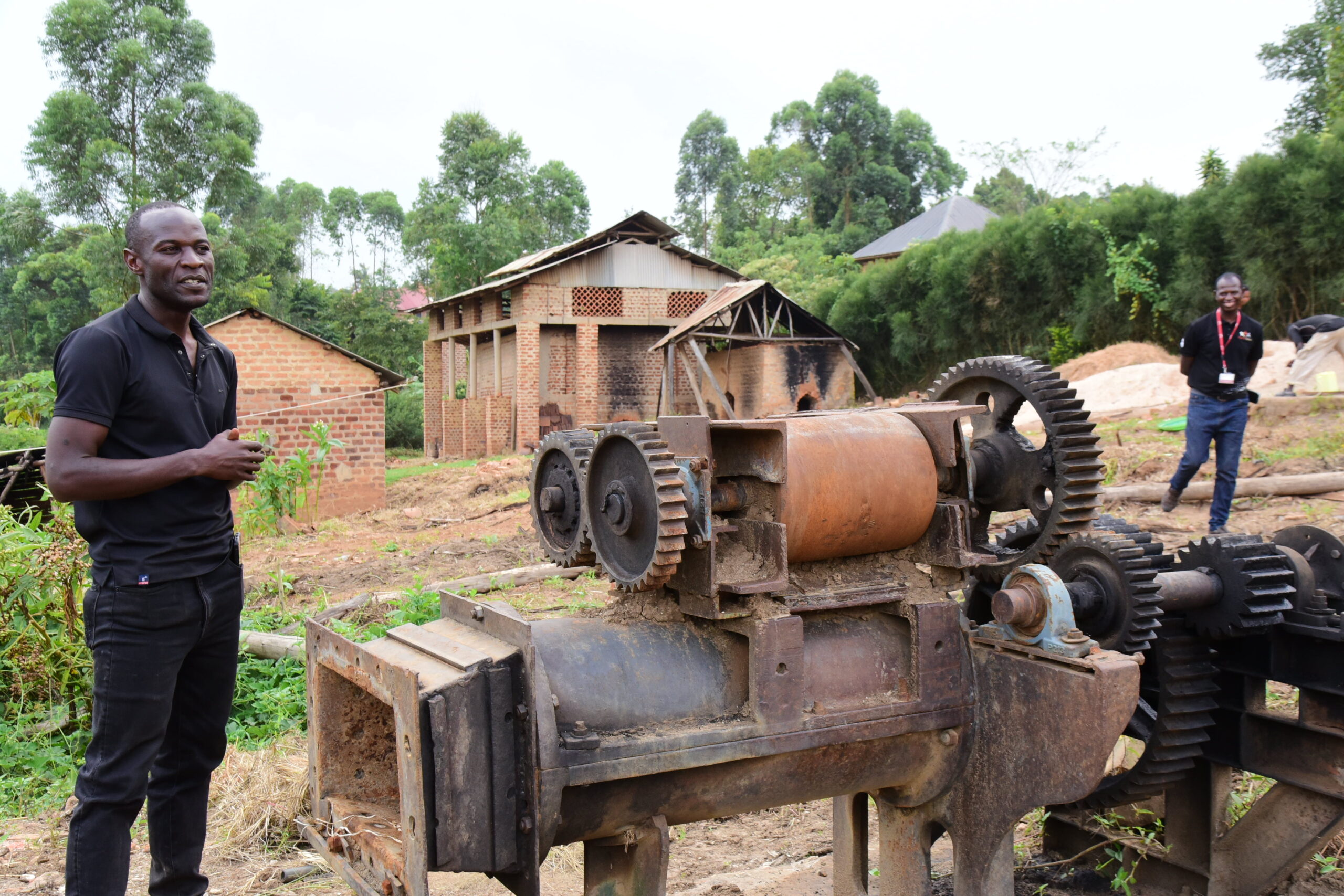
Osward Kakande showing one of the production machines used to make the stoves
When Osward Kakande watched his mother struggle with persistent coughs and headaches caused by smoke from traditional cooking stoves, he never imagined that her suffering would inspire a business now valued at more than Shs450 million.
Today, the founder and director of Mubende Stoves is emerging as one of Uganda’s notable clean energy entrepreneurs, building a company that is improving livelihoods, creating jobs and advancing clean cooking solutions across the country.
What began as a personal mission to protect his family from the harmful effects of indoor air pollution has grown into an enterprise supplying energy-efficient stoves to households and businesses in several districts.
Like many entrepreneurs, Kakande started with little more than determination and a vision. In 2017, Mubende Stoves operated from a modest 20-by-50-foot plot under a simple wooden shelter. With Shs1.8 million borrowed from a friend, Keith, Kakande produced his first batch of 28 stoves.

Kankandes stove ready for sale
“There was no profit in the beginning,” he recalls. “Every shilling went back into buying raw materials.” The breakthrough came during the second production cycle. Manufacturing 120 stoves earned him a profit of Shs3,000 per stove, proving the business could become sustainable.
Years of persistence, reinvestment and a focus on quality followed. Today, Mubende Stoves operates from a three-acre production facility and manufactures a range of products including portable household stoves, wood stoves and Productive Use (PU) stoves designed for businesses.
Uganda remains heavily dependent on biomass fuels, with most households relying on charcoal and firewood for cooking. Mubende Stoves sought to address this challenge by developing energy-efficient stoves that consume less fuel while producing significantly less smoke.
The stoves are made using a combination of clay, sawdust, burnt brick particles and mica enclosed in durable metal casings. The design helps retain heat longer, reduces fuel consumption and lowers indoor air pollution.
For Kakande, the goal was never simply to sell stoves. “It was about helping families live healthier lives while reducing their fuel costs,” he says.
For several years, the enterprise operated as a Community-Based Organisation, focusing on sensitising communities about clean cooking technologies. However, Kakande soon realised that long-term growth required formal business structures.
Registering Mubende Stoves as a limited company proved transformative. The move enabled the business to meet regulatory requirements, strengthen compliance systems, secure reliable supply chains and access larger markets.
Kankandes stove ready for sale
The company’s first major breakthrough came in 2024 when it secured a contract through GIZ to supply 10,000 portable stoves and 5,000 wood stoves.
Successfully delivering the project significantly boosted the company’s reputation and customer confidence. Building on that momentum, Mubende Stoves was selected in 2025 to participate in a Results-Based Financing (RBF) programme implemented by Equity Bank Uganda in partnership with EnDev GIZ.
Through the programme, the company supplied Productive Use stoves to businesses. Unlike conventional funding models, Results-Based Financing rewards suppliers based on verified outcomes, encouraging quality delivery and greater adoption of clean technologies.
The incentives enabled Mubende Stoves to offer the stoves at subsidised prices, making them more accessible to small businesses.
In Kasambya Town Council, restaurant owner Sandra Nakabugo says switching to an eco-stove from Mubende Stoves dramatically reduced her operating costs.
“These stoves accommodate large saucepans, are hygienic and very cost-effective,” she says. Before adopting the technology, she spent about Shs15,000 daily on charcoal and another Shs20,000 every four days on firewood. Today, her fuel costs average only Shs4,000 per day.
“The savings have allowed me to expand my business and invest in poultry farming,” she says. Josephine Mukakibibi, a dairy trader in Kasambya, has experienced similar benefits.
“The sack of charcoal that used to last one week now lasts nearly three weeks,” she says. The savings have helped her educate her five children and build a family home.
As demand for the stoves has grown, so has the company’s workforce. Mubende Stoves now employs 48 people, up from just three employees in its early years. Many of the jobs have gone to young people and single mothers, groups that often face barriers to stable employment.
“We want our growth to create opportunities for others,” Kakande says.
The company now serves markets in Mubende, Fort Portal, Hoima, Masindi and surrounding districts, extending its reach far beyond its original base.
Despite the company’s commercial success, Kakande remains committed to community development. He founded Human Kind, a community-based organisation that supports people living with HIV and has helped establish a dedicated kitchen facility to improve their welfare.
His entrepreneurial success has also enabled him to diversify into transportation, brick making and hospitality. Yet clean cooking remains his primary focus.
As Mubende Stoves approaches a decade of growth, Kakande’s ambitions continue to expand. He is exploring opportunities in the global carbon market, where the company hopes to generate more than 40,000 carbon credits under the Gold Standard certification framework.
Plans are also underway to invest in briquette production and modern manufacturing equipment to increase capacity and meet rising demand.
For Kakande, partnerships remain vital. “The support from partners such as Equity Bank Uganda and EnDev GIZ has been instrumental in our growth,” he says. “We need more technical and financial support to help local companies scale and reach more communities.”
From a wooden shelter financed by a borrowed Shs1.8 million to a company valued at Shs450 million, Kakande’s story is a testament to how innovation, resilience and strategic partnerships can transform a simple idea into a business that improves health, creates jobs and drives sustainable development.
















Leave a Reply