


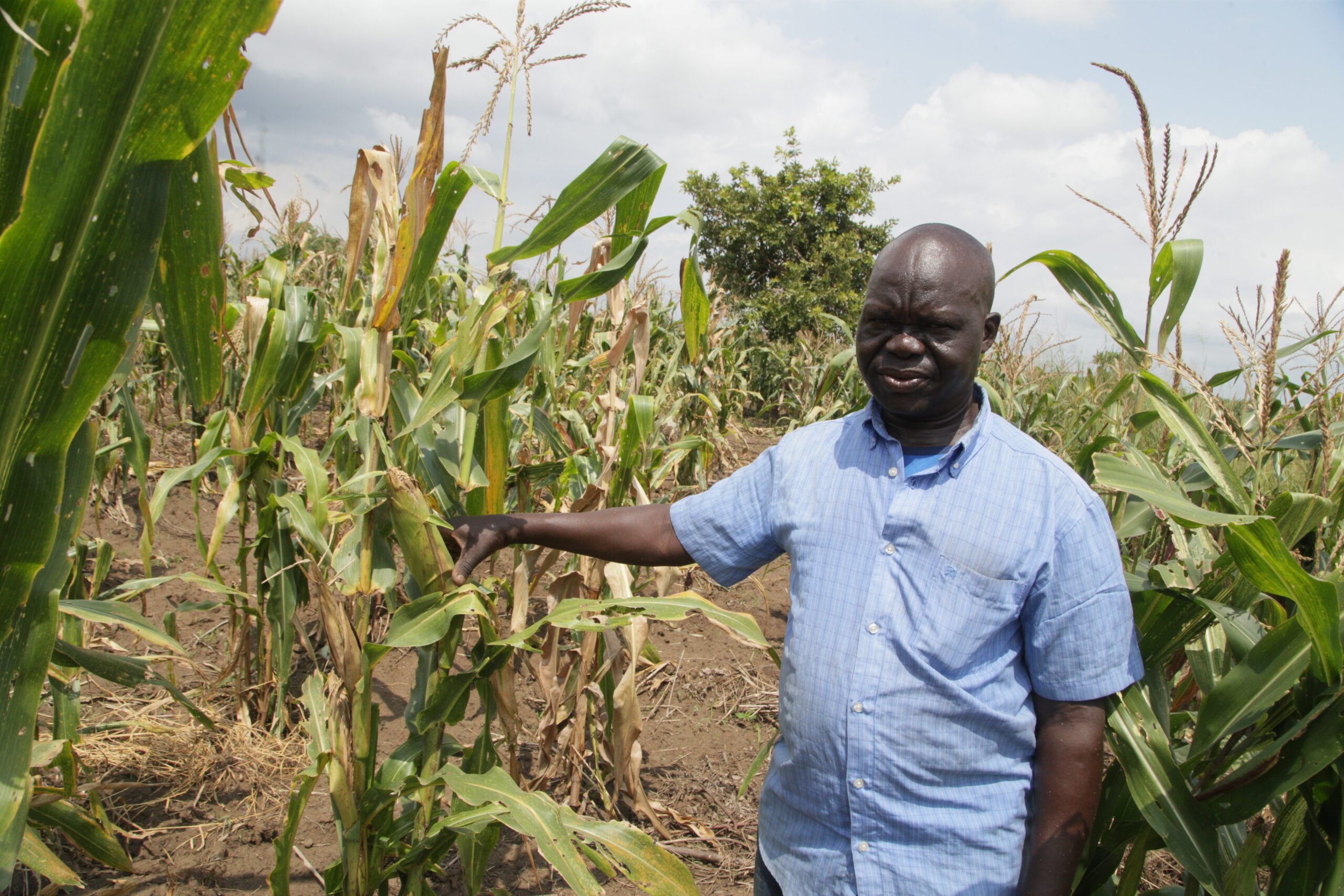
Steven-Dralada-Nzima-inspects-the-growth-of-his-maize-crop-in-farm-located-in-Pariliginya-district-Adjumani-distreict-pointing-out-developing-ears-ahead-of-the-upcoming-harvest
At first light in Pagirinya, Adjumani District, the farm is already alive. Workers move through rows of cassava and maize as machinery prepares land for another planting season. Cattle graze nearby, while the day’s work of planting, harvesting and processing gets underway.
The farm belongs to Steven Dralada Nzima. A hive of activities on his farm is the result of a journey that began far from the fields he now owns. For 20 years, he worked as a security guard in Kampala, guarding offices and commercial buildings.
Today, the former security guard is a commercial farmer, managing hundreds of acres of crops, plantation forestry and livestock, while creating employment for people in his community.
His story is one of disciplined saving, purposeful borrowing and the determination to turn income into productive ventures.
Dralada’s journey was shaped by adversity. The two-decade Lord’s Resistance Army insurgency disrupted life in his home area of Pagirinya. Following the early death of his father, he also had to assume full responsibility of 12 siblings.
This forced him to move to Kampala in search of green pasture in 1995. He joined Saracen Uganda Limited as a security guard on a starting salary of Shs100,000 a month. Among his assignments was guarding corporate offices, including Equity Bank Uganda’s head office at Church House.
It was in 2010 that he first encountered Equity Bank Uganda as a guard at a branch. He was encouraged by Bank staff to open his account. And from that moment, rather than spend his modest earnings, Dralada treated his salary as a foundation for the future. He saved consistently and participated in informal peer-lending arrangements with colleagues, gradually building his financial base.
“Kampala teaches you how to handle money. It shows you that everything has value, even the small things,” he says. Adding, you pay rent, buy even water to drink, and have no room to expand.”
“This inspired me to even save more; I was unhappy with paying for everything because back home in the village, we don’t pay for water. I realised I had to return home to build something lasting. I saved every increased shilling of my salary, every bit of it, I was annoyed,” said Dralada.
In 2018, after nearly two decades serving as guard, Dralada returned to Pagirinya village, in Adjumani District.
He combined his NSSF payout of UGX21million with the UGX26 million from property compensation from the National Roads Authority to acquire more land, buy seeds, seedlings and hired a tractor to open land.
The transition was not easy. Commercial agriculture requires inputs, machinery and, importantly, the ability to work within the farming calendar.
In Adjumani, farmers often struggle to access farm tools such as tractors and have to hire machinery from neighbouring districts of Gulu and, sometimes, as far as Kiryandongo. Delays can mean equipment arrives after the critical early rains.
Dralada decided to solve the problem. In 2022, he approached Equity Bank Uganda for agricultural asset loan to purchase a tractor. The investment transformed his production cycle. Instead of waiting for hired tractor, he was now able to prepare his gardens on time and plant on time.
“When the Bank managers visited my farm and saw 140 acres of mature cassava and several acres of maize, they recognised the potential of my farm,” Dralada recalls.
The visit also came with a lesson in responsible borrowing. “I still recall clearly our conversation. Manager told me, ‘This money we are giving you is not personal money, it is people’s money. Use it wisely, pay back the loan well, and do not disappoint us.’”
Dralada took the lecture on money management to heart. “We followed that advice strictly. A trust had been placed in my head. I repaid the loan smoothly while keeping our savings growing,” he says.
The results of mechanisation were soon visible. In his first season of 2023, he harvested more than 300 bags of maize. His enterprise has since grown to include 140 acres of cassava, 35 acres of maize, 20 acres of groundnuts and 20 acres of rice. He also grows sweet potatoes, sorghum, groundnuts and simsim.
He has also established 140 acres of teak and mahogany trees. His livestock enterprise includes over 60 cattle and goats and now adventuring into apiary.
Growth on the farm has also translated into jobs. Dralada directly employs 15 full-time workers at his Zoka farm and 45 seasonal workers.
As the farm has grown, so have Dralada’s investments. Profits have enabled him to diversify into cargo tricycle business and a heavy-duty maize thresher. He hires them out.
He is now looking beyond producing raw agricultural commodities.
Working with Equity Bank, he is formalising the enterprise as a limited liability company, a step he hopes will open access to bigger markets in South Sudan and DR Congo.
His expansion plans include acquiring three more tractors, taking his fleet to five. Beyond serving his own farm, the machinery will enable him to offer mechanisation services to neighbouring farmers.
He is also seeking financing for a Shs70 million maize cob grinder and seed-cleaning plant, as well as a heavy transport truck to move bulk produce directly to regional markets.
The ambition is clear: to capture more value from every harvest by producing, processing and transporting his own agricultural output.
For Gift Shoko, Managing Director of Equity Bank Uganda, Dralada’s journey demonstrates what can happen when access to finance is matched with discipline and an enterprising spirit.
“Access to formal banking gives people economic autonomy. That is our core purpose: transforming lives and restoring dignity to individuals and communities through accessible financial services,” Shoko says.
Dralada’s journey has taken him from standing guard outside Equity bank premises in Kampala to becoming one of its most valuable customers in Adjumani district.
His story is ultimately about more than farming. It is about turning years of modest earnings into a foundation for growth and showing how the right investments can create opportunities that extend beyond one person to a family and an entire community.







Leave a Reply