


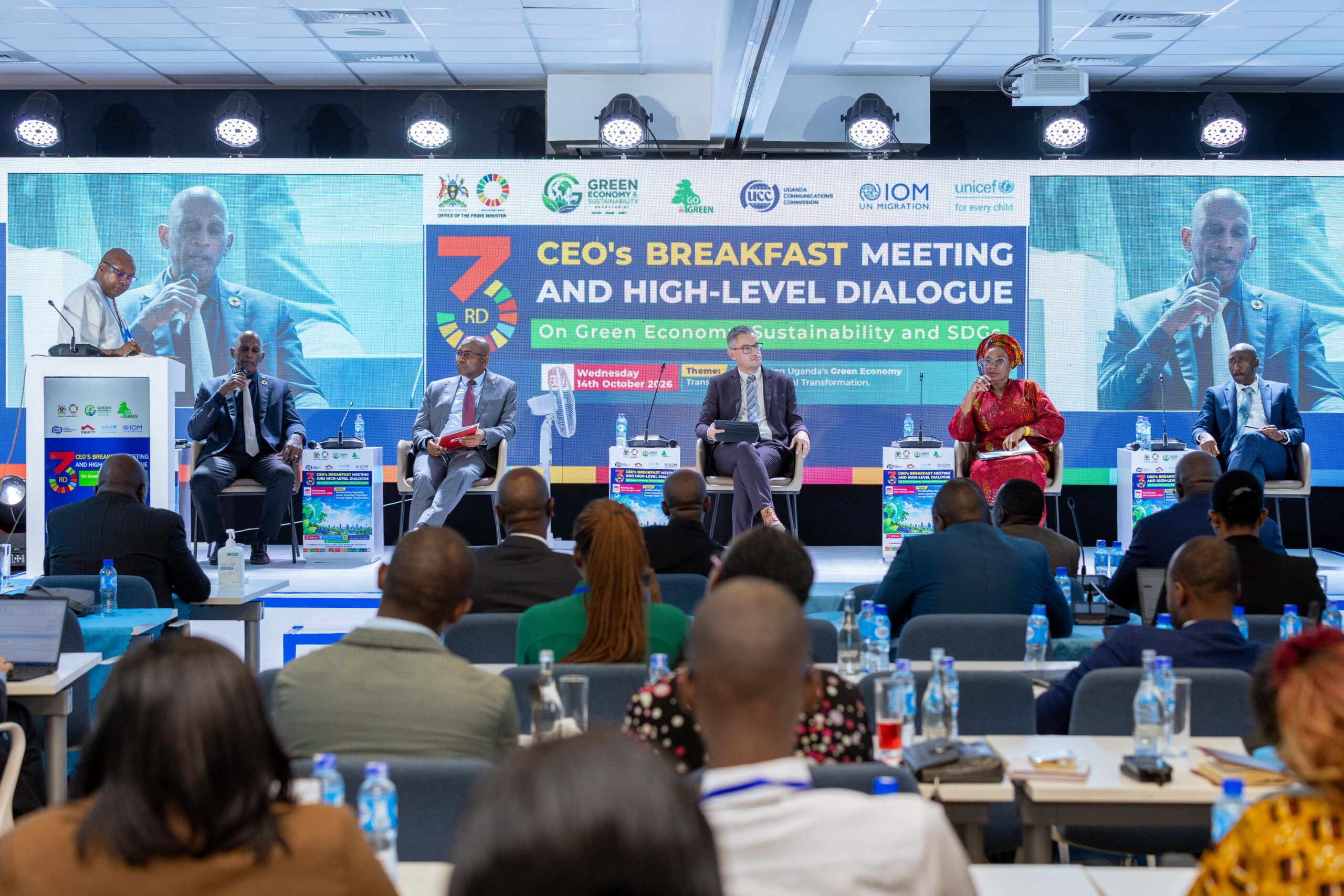
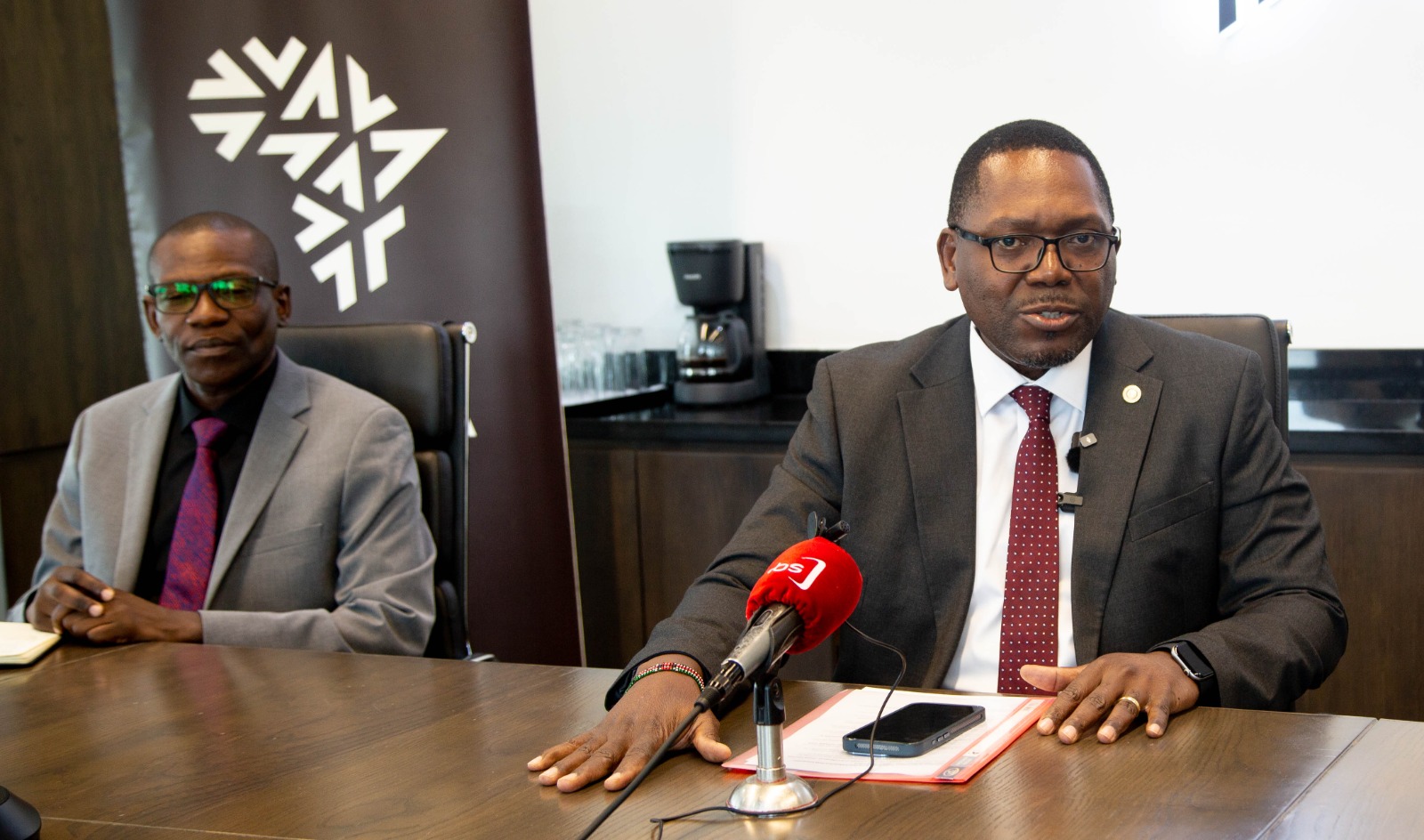
Equity Bank Uganda MD Gift Shoko sits with other panellists during the panel session at the 3rd CEOs’ Breakfast Meeting to Advance Financing for Uganda’s Green Growth
Equity bank Uganda was a proud sponsor and partner at the 3rd CEOs’ Breakfast Meeting & High-Level Dialogue on Green Economy, SDGs & Sustainability.
The event was held on Wednesday 14th October at the UNICEF Conference Centre in Mbuya under the theme ‘Accelerating Uganda’s Green Economy Transition Through Digital Transformation’.
The high-level gathering brought together senior leaders from government, the private sector, development partners and civil society to accelerate action on climate-resilient growth and sustainable financing.
Equity bank Uganda Managing Director Gift Shoko delivered a keynote panel address and actively contributed to the debate on bankable green projects, underscoring the critical role of financial institutions in mobilising capital for renewable energy, climate-smart agriculture, clean cooking, water and sanitation, and sustainable enterprises.
Equity Bank Uganda MD Gift Shoko gives his remarks during the panel session at the 3rd CEOs’ Breakfast Meeting to Advance Financing for Uganda’s Green Growth
Speaker of the Parliament of Uganda Jackson Oboth served as Keynote Speaker and Guest of Honour. Other distinguished speakers included the UNICEF Country Head for Uganda, the World Bank Country Manager, and the Heifer International Country Manager, among others.
The event was attended by key partners including the Office of the Prime Minister, Go Green, the Uganda Communications Commission (UCC), IOM UN Migration, UNICEF, Enabel, Uganda Railways, NEC Uzima Limited, and the Uganda Printing and Publishing Corporation.
Gift Shoko detailed Equity bank Uganda’s concrete contributions to date, including: UGX 37.6 billion disbursed in green loans for climate finance, support for the sale of 157,035 clean-energy products, onboarding of 18 clean-energy implementing partners, UGX 4.75 billion in green finance funds through a partnership with the Uganda Energy Credit Capitalisation Company (UECCC) and contribution to the planting of 96,638 trees over the past three years.
He also highlighted Equity Group’s recent USD 200 million agreement to support smallholder farmers, micro and small enterprises through smart agriculture and related interventions, of which Uganda is set to access approximately 25 percent (around USD 50 million).

Equity Bank Uganda MD Gift Shoko with other panellists after the panel session at the 3rd CEOs’ Breakfast Meeting to Advance Financing for Uganda’s Green Growth
Additional tree-planting initiatives, including partnerships with schools so that students own and nurture trees, were shared as part of longer-term environmental stewardship.
Equity bank Uganda has in the past planted trees at several schools as part of its environmental initiatives, including the Equity Green Schools Programme targeting 200,000 trees by 2027. At Nakanyonyi Secondary School in Mukono, about 3,500 trees were planted during the programme launch, while 1,500 trees were earlier planted at Kyasanku Hill College in Mpigi. St. Julian Secondary School in Wakiso received 1,000 trees in a 2025 campaign, and Busoga College Mwiri saw over 43,000 indigenous trees planted across its hill slopes. The broader programme aims for 50,000 trees across 25 schools in 10 districts by the end of 2026, with more to follow through school orchards.
In the interactive session, discussions turned to balancing green economy investments with truly bankable projects, employee wellness as a foundation of organisational sustainability, targeted support for women (including those over 40) and youth, and the need to scale successful models beyond individual organisations.
Equity bank Uganda outlined its approach of institutionalising support for women and youth, expanding wellness partnerships, deploying the Young Africa Works framework, and prioritising financial literacy and capacity development (with over 100,000 youth trained) alongside access to appropriate finance.
“The question is no longer whether Uganda can afford to invest in sustainability. The question is whether we can afford not to,” Shoko stated.
“At Equity bank Uganda we are committed to mobilising finance, expanding access to sustainable solutions and building the partnerships that will accelerate Uganda’s green transition. When government provides the enabling environment, the private sector innovates, development partners catalyse investment and financial institutions mobilise capital at scale, Uganda will not merely participate in the green economy, it can thrive through it.”
Equity Bank Uganda reaffirmed its commitment to using finance as a force for sustainable transformation, aligning with its purpose of transforming lives, giving dignity and expanding opportunities for wealth creation.
Key discussions focused on the urgent need for climate action and practical pathways to scale green finance with speakers highlighting rising temperatures, increasingly unpredictable rainfall, and the growing threats these pose to agriculture, livelihoods and economic progress in Uganda.
Calls were made to protect wetlands, restore degraded land, invest in renewable energy, and translate boardroom conversations into actionable regulations and individual responsibility.
Emphasis was placed on ensuring economic transformation and the protection of natural systems coexist, with a strong reminder that current generations must plant and act for those who will come after them. Participants explored opportunities and challenges in attracting sustainable investment capital, strengthening the ecosystem for green finance, and leveraging technology to accelerate the green transition, particularly through improved energy management, expanded access to clean energy, climate-smart agriculture and enhanced resilience.
Entrepreneurship, private-sector innovation and multi-stakeholder partnerships were identified as essential drivers.
The private sector’s role in resource mobilisation and public-private collaboration was repeatedly underscored as critical to moving from isolated interventions to national-scale solutions







Leave a Reply