


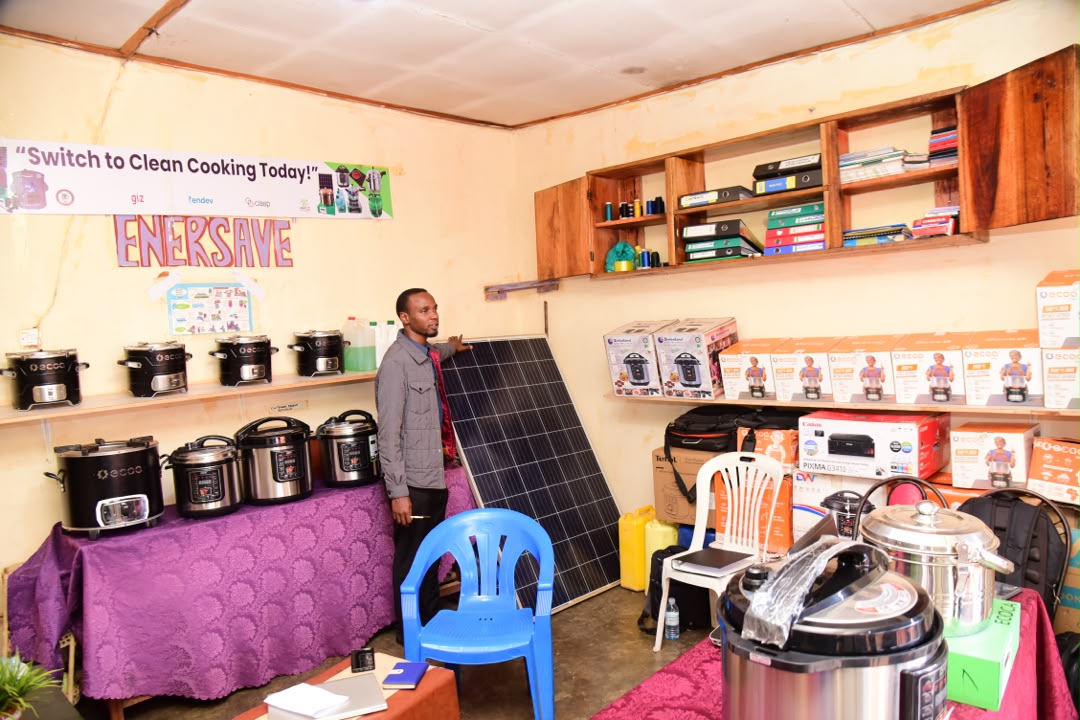
Emmanuel-Bassa-the-director-of-Enersave-Enterprises-Limited-showcasing-some-of-the-solar-technologies-offered-by-the-company
Less than two years after its establishment, Enersave Enterprises Limited has transformed from a fledgling clean energy business into one of Uganda’s emerging players in the clean cooking sector, earning recognition as a hub under the Uganda National Alliance on Clean Cooking (UNACC).
The achievement marks more than just institutional recognition. It reflects how targeted financing, strategic partnerships, and growing consumer demand are helping local enterprises accelerate Uganda’s transition to cleaner, more sustainable cooking solutions.
Founded in 2024 and based in Baggala Zone, Seeta in Mukono District, Enersave Enterprises Limited was established with a mission to increase access to clean cooking technologies across Uganda. The company supplies electric pressure cookers (EPCs), solar-powered cooking solutions, biogas systems, improved cookstoves and ethanol technologies, while also conducting community sensitization and training on clean energy.
Its breakthrough came through the Results-Based Financing (RBF) programme implemented by GIZ EnDev in partnership with Equity Bank Uganda, which provided the financial support needed to scale its operations.
Under the programme, Enersave supplied 301 electric pressure cookers to households across 30 districts, achieving its distribution target while significantly expanding its national footprint.
“The funding we received provided us with working capital that boosted our business operations,” says Emmanuel Bassa, Director of Enersave Enterprises Limited.
Emmanuel-Bassa-the-director-of-Enersave-Enterprises-Limited-showcasing-the-ecostoves-offered-by-the-company
“Initially, we only dealt in electric pressure cookers. Through the programme, we diversified our product portfolio to include solar cooking solutions, improved cookstoves, ethanol and ethanol stoves. These products were well received by communities, enabling us to achieve 100 percent of our EPC distribution target.”
Today, the company serves customers in more than 50 districts, nearly doubling its geographical reach within a short period.
Beyond increasing sales, the Results-Based Financing programme strengthened Enersave’s internal systems, positioning the company for future investment.
To qualify for funding, the company developed key governance structures, including gender and human resource policies, while also producing audited financial statements.
These reforms have significantly enhanced the company’s credibility.
“We are now investor-ready because of the structures we put in place,” Bassa explains. “We have governance systems, audited books of accounts, and institutional policies that make us attractive to future investors. We also became members of the Uganda National Alliance on Clean Cooking, which will further support our growth.”
The Electricity Regulatory Authority (ERA) and Uganda Electricity Distribution Company Limited (UEDCL) introduced a reduced cooking tariff, enabling domestic consumers to purchase a 70-unit cooking bundle at Shs 412 per kilowatt-hour for consumption between the 81st and 150th units.
The lower tariff is encouraging households to shift from charcoal and firewood to electric cooking technologies.
“Many Ugandans want solar systems, clean cookstoves, and renewable energy solutions, but the initial costs remain too high for households and small businesses. Equity Bank partners with companies like Enersave to bring these services closer to them,” Virginia Semakula, Equity Bank Energy, Environment and Climate Change Pillar Head notes.
For Rose Nakayiba, a resident of Bugina Zone in Seeta, buying an electric pressure cooker has significantly reduced both her cooking expenses and time in the kitchen.
“I was initially worried about the electricity bills,” she recalls.
“But after buying one EPC and seeing how economical it was, I bought a second one. I use about one unit of electricity to prepare a meal, which is much cheaper than buying charcoal. Previously, I spent about UGX 80,000 every month on charcoal.”
She adds that the appliance has also improved convenience.
“Whenever I travel, I carry my EPC because I can cook anywhere there is electricity. It keeps my kitchen clean and saves me a lot of time regardless of what I am preparing.”
Another customer, Specioza Nalule, says the savings from switching to electric cooking have created new economic opportunities.
“As a housewife, I now save the money I used to spend on charcoal. I contribute those savings to a weekly women’s savings group and I plan to invest the money in my poultry business.”
Enersave’s expansion has extended beyond commercial success. The company has established a Community-Based Organisation (CBO) that equips young people with vocational skills, including embroidery, while promoting clean energy awareness.
It has also participated in numerous clean cooking exhibitions and expos across Uganda, reaching more than 1,000 people with demonstrations and training on clean cooking technologies.
According to the company, these initiatives have strengthened its brand visibility while driving business growth.
As Uganda intensifies efforts to increase access to modern energy, Enersave sees significant opportunities beyond urban centres.
The company plans to expand its range of clean cooking technologies, particularly solutions suitable for off-grid communities where access to reliable electricity remains limited.













Leave a Reply